
On Tuesday, I attended a UC Berkeley math and physics panel event called “Math: The Universe’s Language or Human Creation?” at the Lawrence Hall of Science Auditorium, not far from Cal Bears’ Memorial Stadium and the Botanical Garden.

Why did I go? I’m in tech. Success in understanding tech means knowing something about math. Math is the basis for technology innovation, e.g. it takes probability mathematics at the base to ‘guide’ a robot in choosing its next move. Most people think everything tech revolves around computer science and engineering. The best physicists, programmers, and chemists are decent mathematicians.
Mathematics underpins various technological advancements across AI, data analysis and healthcare. According to the media outlet FinTech Weekly, machine learning and data analytics greatly rely on math models and statistics.
The panelists included award-winning physicists including a Dean, a Chancellor’s chair and Berkeley’s most famous mathematician Professor Kenneth Ribet who is teaching linear algebra in the Fall.
Ribet is known for the Herbrand–Ribet theorem and Ribet’s theorem, which were key parts of the proof of Fermat’s Last Theorem, as well as for his service as President of the American Mathematical Society or the AMS from 2017 to 2019.
During the afternoon’s networking sessions, I chatted with a Post Doctoral student from Germany, a Japanese student visiting from Tokyo, a Cal dad who was also a Fields Medal winner, another parent, and a transfer student from SoCal who had recently been admitted to the chemistry department.
Trekking to The Hill
Just getting to ‘The Hill’ from the South Bay was an adventure. I took the BART train from Berryessa station in San Jose to the Downtown Berkeley stop and walked to Evans Hall, the 10 story math building, then took the Bear Express H bus – for only $1 cash – up to Lawrence Hall of Science. H stands for Hill apparently. I grabbed a healthy snack at the Press Cafe near Memorial Glade on the way.

This bus ride could be a tourist attraction due to the views which included the Bay and Karl the Fog. It’s just past the Berkeley Botanical Garden but I didn’t notice sidewalks so the bus or Uber or car are recommended. Parking at the science hall is $1.50/hour and is done by PaybyPhone app.
The Hall of Science reminded me of The Exploratorium with many kids activities.Three workers who were also Cal students taught me how to tell if a skull belonged to a creature that walked on four legs.
Back to the panel. Here’s the description, list of speakers, and comments.
Is Mathematics a human invention, or is it woven into the fabric of reality? The description was, an “engaging panel of physicists and mathematicians as they explore whether math is a universal truth waiting to be uncovered or a tool of human creativity. This fun and thought-provoking discussion, open to all curious minds, will be followed by a sunset cocktail hour where attendees can meet the speakers and continue the conversation over refreshments.”
Kenneth A. Ribet, Professor of Mathematics
Mina Aganagic, Chern-Simons Professor in Mathematics and Physics
Raphael Bousso, Professor and The Chancellor’s Chair in Physics
Steven Kahn, Dean of Mathematical & Physical Sciences
Moderated by Stephen Sharpe, Cal Alum ’83, from University of Washington
Here are some of the comments they made:
Dean Steven Kahn:

We use mathematics to make predictions then use that information in experiments. Math is the science of pure thought. Compare math to chess, a human invention. There are tactics to win at chess. Math is like this. Math is incredibly successful at explaining nature.
We’re prejudiced to believe in individuality but some cultures are not like this.
He described the cultural aspect of math. A man tried to explain to his dad, a merchant, what a negative number is. The merchant just didn’t get it. Then finally the son said, dad, it’s like you owe something.
Professor Mina Aganagic:
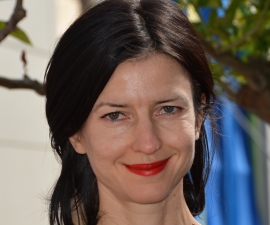
This string theorist and physics professor referenced the discovery of magnetics and Isaac Newton, as well as string and number theories.
She said that mathematicians have found inspiration in physics. She was skilled at focusing on a specific message because she repeated this a few times.
Professor Aganagic said that physics proves connections.
Professor Kenneth Ribet:

Consider that a long time ago, mathematicians in different countries who didn’t talk to one another figured out the same things. Therefore math is out there waiting to be discovered.
Global collaboration and learning other types of things, not just your own area, can lead to a math discovery.
Ribet stressed that collaborating globally is key to breakthroughs as is learning about math beyond your specific expertise. This is how you truly innovate.
In math, you choose something to focus on and then extract something from it. You introduce something that wasn’t there before.
He mentioned books like, “God Made the Integers” by Stephen Hawking which is about mathematical breakthroughs that changed history.
Mathematicians don’t understand physics, which resulted in many laughs from the audience.
Professor Raphael Bousso, Chancellor’s Chair in Physics:

He doesn’t care for the word “discover” because it is overused. Like, you might say, I lost my iPhone and then discovered it.
Math came to be in three ways: 1) It’s inspired by the physical world. 2) You write down axioms. This is the creation part. 3) Then deduce theorems.
Take for example, geometry. Play with axioms for a new kind of geometry to describe space and time. Axioms help formulate. One of my colleagues came up with something amazing using facts from 100 years ago.
Math helps us make predictions and more accurate ones. Consider that Kepler’s Law was succeeded by Einstein’s theory of space and time. (As background, Einstein’s Theory of Relativity showed Kepler’s laws of planetary motion were foundational but imperfect.)
Using math and calculations you can make this either easier or harder.
Key Takeaways
Math has played a critical role in the advancement of physics, from Einstein’s theory of relativity to Newton’s laws of motion. It has been key in furthering our understanding of the universe and has provided insights in the nature of the physical world.
I learned from this panel that mathematicians can achieve breakthroughs by building off of past works. These works can go back hundreds of years.
The panelists were split on whether math was created by man or already out there in the universe waiting to be discovered. More than half of the audience made up of a lot of STEM folks felt that it was a combination of both. I agree.
Photo credits: Michelle McIntyre took the photos of the panel event, Bear bus, and view from the Lawrence Hall of Science, below. The four speaker headshots came from UC Berkeley’s website.
###

Michelle McIntyre is public relations consultant and a UC Berkeley math mom ‘alum.’ She stays on top of STEM trends through events like this. Her son graduated from UC Berkeley with a degree in mathematics and is a rising third year PhD math student at Duke.
 ––––––––––– MMC ––––––––––––– Michelle McIntyre Communications