
The Duke Alumni and Parents group invited me to a series of lectures on space industry trends, problems and solutions. I’m half-way through. My plan was to take a Stanford class this Spring but Duke stole me away for their series. I love learning so it’s been fun.
I learned that space exploration helps us in many areas of our lives and that U.S. priorities are going back to the Moon after 50 years, putting humans on Mars and enabling long term survival on the Space Station. For example, they are trying to figure out how to make medical IVs work there.
Lecture series speakers include Duke physics and engineering professors, their alums who work in private industry, and executives from places like NASA and the Duke Lemur Center.
The ones who stood out to me were Duke Alumni Jonah Embry-Seckler of Rocket Lab and Alison Korn of SpaceX. Korn has a mechanical engineering degree, was in the Duke Arrow club and took aerospace classes there. She said her club work helped her get a Boeing internship and job at SpaceX.
Here are 10 ‘far out’ things I learned so far:
- We are losing the night sky! Darkness is going away with so many things being launched into space. My research beyond class revealed that decreasing darkness disrupts nature and ecosystems.
- There’s an increased risk of things crashing in space. Most countries can launch whatever they want into space.
- This is not a very regulated area especially with the new hands-off Federal administration. Duke Physics Professor Daniel Solnic recommends more regulation.
- Exploration of extreme environments like the North Pole helps us understand other planets, e.g. studying Utah’s Great Salt Lake is like Mars.
- GPS is being attacked, according to a Washington Post story.
- There’s been a rapidly challenging landscape in the funding related to space, e.g. NSF has halted all funding related to any new exploration of the North or South poles.
- We only understand 5% of what we observe. We ask, what is it; how does it get here?
- Scientists study animal hibernation to understand the ways that humans can survive longer on the Space Station. There’s cold and warm weather hibernation.
- University groups like rocket club and certificate programs can help a student focus on a career choice if the major is not offered. Duke Arrow rocket club is a way a student can get hands-on learning and more easily get an aerospace engineering job later.
- Space exploration helps society in many ways. Apple’s SOS technology which has been used to save lives resulted from its exploration.
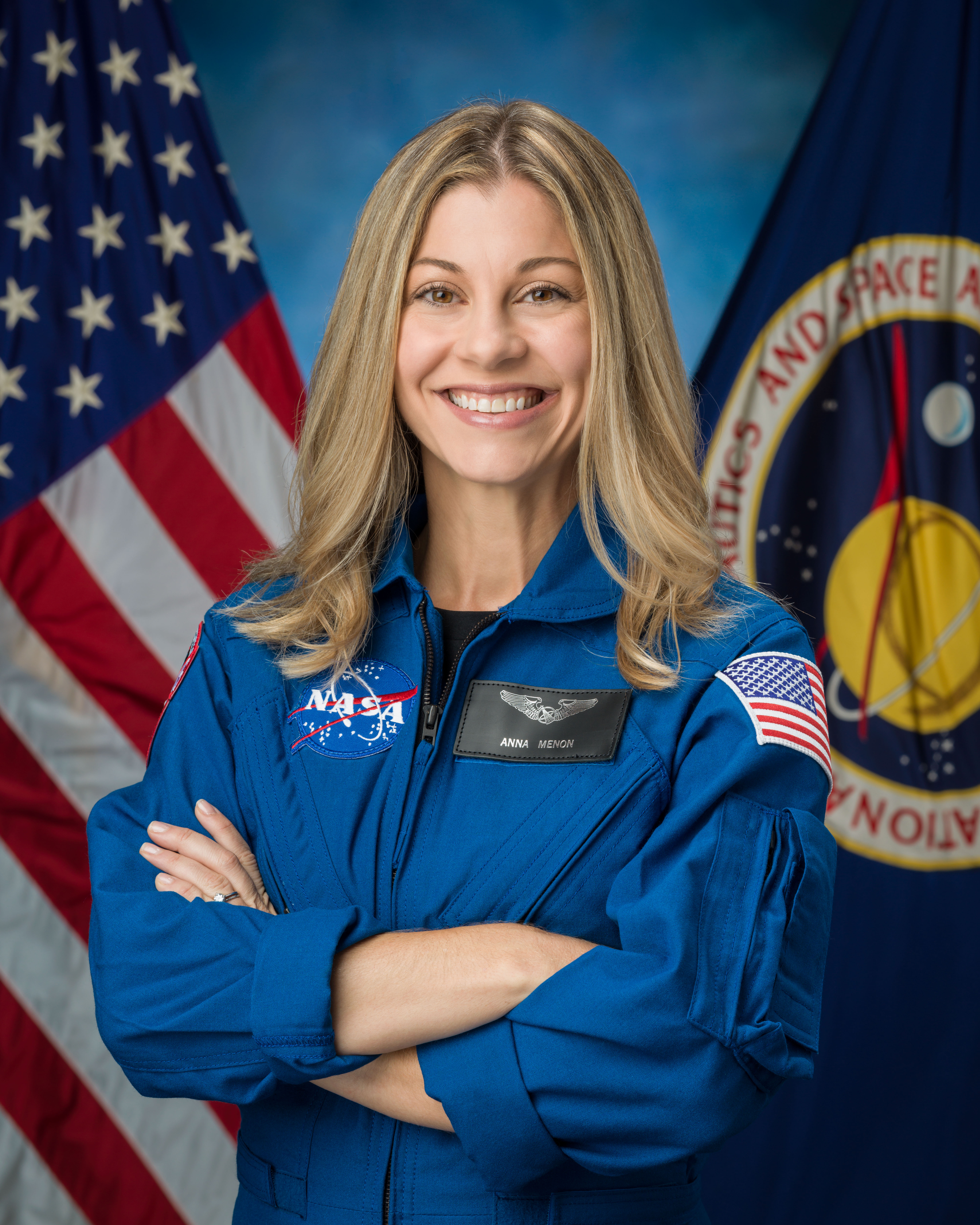
Duke Alumna Anna Menon (See Wikipedia photo) who is in NASA’s newest astronaut class was mentioned during the first lecture. She might be the first person on Mars or first woman on the Moon. This is from NASA’s new astronaut class announcement:
A graduate of Duke University with a master’s in biomedical engineering, (Anna) Menon began her career at NASA as a biomedical flight controller, ensuring the health and safety of astronauts aboard the International Space Station. Her role included managing medical hardware and software from Mission Control, preparing her for the challenges of supporting human life in space.
As stated earlier, it seems like space priorities are learning how we can live longer and more successfully on the Space Station, visiting Mars and going back to the Moon. Be aware of the Artemis II Moon mission, which was mentioned in the first Duke class. I researched this and it looks like it’s scheduled for April. Pretty cool and, ‘far out!’
###
Michelle McIntyre is a Silicon Valley public relations consultant and parent of a Duke mathematics PhD student. The photo is from Wikipedia.
 ––––––––––– MMC ––––––––––––– Michelle McIntyre Communications