
The president and CEO of the Federal Reserve Bank of San Francisco, Mary C. Daly delivered remarks on monetary policy and the economy at the Commonwealth Club in San Francisco which is in a sweet location at 110 Embarcadero, in between Fisherman’s Wharf and AT+T Park where the San Francisco Giants play. (Photo of Deirdre Bosa of CNBC and Daly is by Jeannie Entin.)
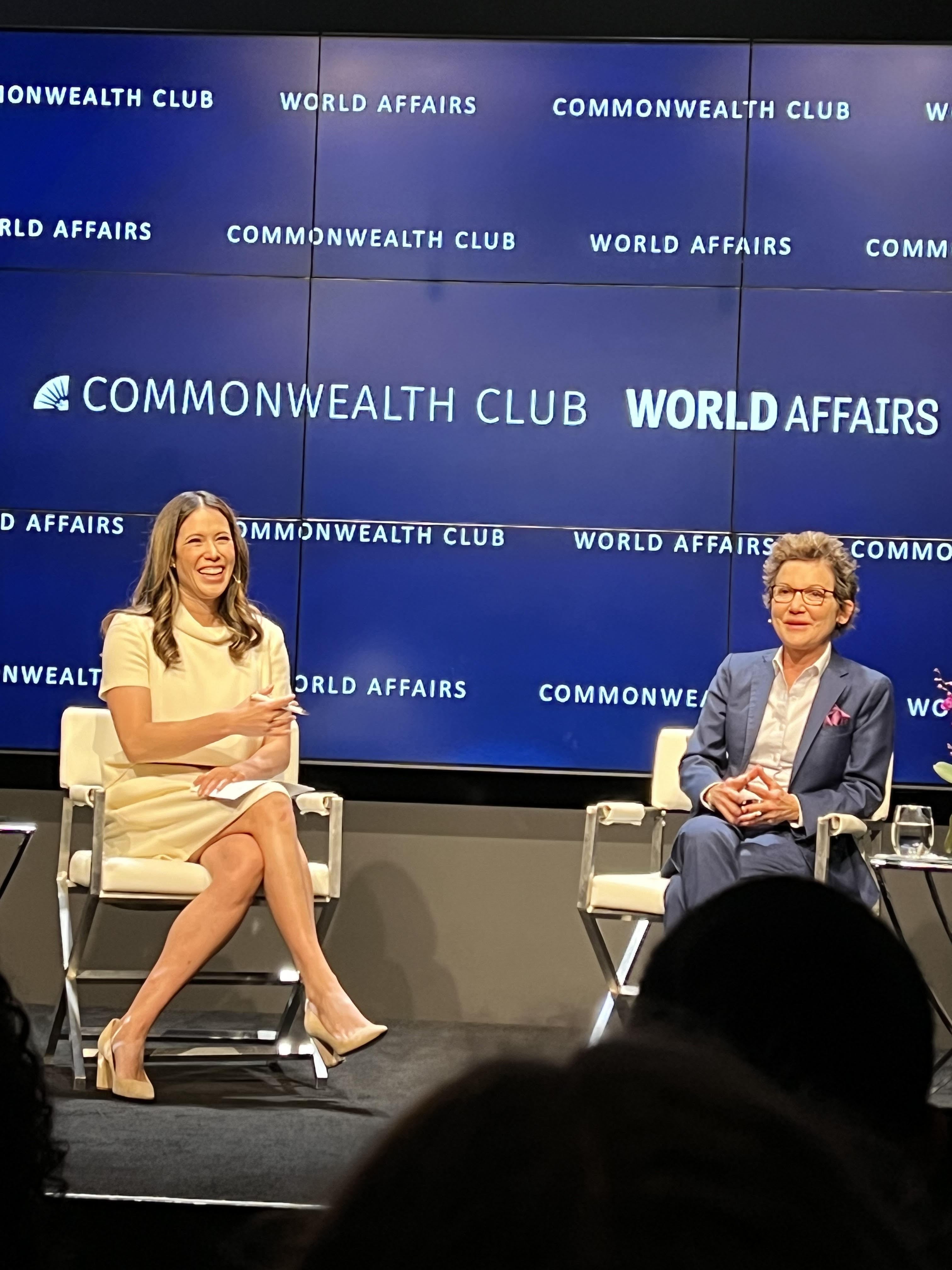
Naturally Daly focused on inflation and jobs which is what a lot of we citizens care about the most. I was dismayed seeing my dog Ringo’s Rachel Ray brand dog food go from $17 to $34 due to inflation. The good news is that the new cost has stuck for a while. If it doesn’t go up soon I’ll be happy! (The Ringo photo by me is below. He’s a big boy and eats a lot of dog food.)

Daly, who holds an undergrad degree from University of Illinois and a PhD from Syracuse University, said, “We (The Federal Reserve) need to restore price stability and do so without a painful impact on the economy.” She added, “We are still in a fight to bring inflation down to two percent.”
What is Inflation at Now?
Inflation looks like it’s around three percent according to the U.S. Inflation Calculator website. This is a very cool chart. Check out the year it was at 7%.
She said that people are confident that inflation will come down to two percent. She added that the decline in unemployment is declining more slowly than the decline in inflation. Monetary policy is working but it will take more work, added Daly. She also said that the Bay Area has a lot of innovation that could come and help productivity. She touched on supply and demand and how that affects the economy. (Argh. Thoughts of Econ 101 and 102 undergrad classes are flowing back into my brain. I simultaneously love and hate this topic. Understanding the economy is important if you have a career in public relations. We typically spend a lot of time with company leaders and sometimes advice on business strategy.)
But, Daly added, things are pretty much in balance, in regards to demand and supply of workers.
Look back to 2022 Daly says. At one point, unemployment was very low and job vacancies were high. As interest rates rose, the vacancies reversed. In April 2024, the vacancies slid down, as per her graphic. We need to have the labor market slow down a bit to bring inflation down, says Daly.
My opinion is this is the stressful thing about the economy. If companies hire a lot they have less money. They lay off and stock prices might go up. Running a business is tricky business! Back to Mary…
Mary C. Daly summarized by saying, “We are in a better place than 2023. Inflation has come down and the labor market is solid. But we are not there yet. To thrive, people need price stability and jobs.”
I can hear that Queen song in my head. “I want it all. And I want it now.” Balance is hard but I think the Fed is doing a good job. Hopefully my beloved Rachel Ray dog food will stay the same price for a long time!
As an aside, Daly is a great speaker and from the MidWest like me. I could hear that Midwest roots vibe in her messages. Although I love the location of the Embarcadero near all of the cool touristy stuff, I attended Daly’s talk online.
Thanks San Francisco Press Club for streaming it and making it very easy to attend. I serve on the board of PRSA Silicon Valley with Curtis Sparrer who is the president of the SF Press Club and he extended a personal invitation to me. Curtis is a busy bee.
Look for a more detailed story on this talk from Jennifer Yoder on the PRSA Silicon Valley website soon. Deirdre Bosa, anchor of CNBC’s tech-focused franchise, “TechCheck,” based out of the network’s San Francisco Bureau, interviewed Mary C. Daly on stage after her remarks. Yoder’s story will incorporate more of what Bosa said. Here is the YouTube video URL: https://www.youtube.com/watch?v=hrY3957xQ-A
In closing, here is a reminder of what we learned in econ 101 class taken verbatim from the Federal reserve website:
How does the Federal Reserve affect inflation and employment?
As the Federal Reserve conducts monetary policy, it influences employment and inflation primarily through using its policy tools to influence the availability and cost of credit in the economy.
The primary tool the Federal Reserve uses to conduct monetary policy is the federal funds rate—the rate that banks pay for overnight borrowing in the federal funds market. Changes in the federal funds rate influence other interest rates that in turn influence borrowing costs for households and businesses as well as broader financial conditions.
For example, when interest rates go down, it becomes cheaper to borrow, so households are more willing to buy goods and services, and businesses are in a better position to purchase items to expand their businesses, such as property and equipment. Businesses can also hire more workers, influencing employment. And the stronger demand for goods and services may push wages and other costs higher, influencing inflation.
During economic downturns, the Fed may lower the federal funds rate to its lower bound near zero. In such times, if additional support is desired, the Fed can use other tools to influence financial conditions in support of its goals.
However, there are many factors that affect inflation and employment. And while the linkages from monetary policy to both inflation and employment are not direct or immediate, monetary policy is an important factor.
###
Michelle McIntyre is a PR consultant, IBM vet and head of marketing for PRSA Silicon Valley. She is a Quora influencer in the area of elite college admissions, with 1.9 million views there. McIntyre, a graduate of Ohio University’s EW Scripps School of Journalism currently has a 4.0 GPA in Stanford Continuing Studies. Jeannie Entin who snapped the beautiful event photo for this story is the president-elect of PRSA Silicon Valley.



 ––––––––––– MMC ––––––––––––– Michelle McIntyre Communications