
Listen Up, AI Startup Founders! VC Legends Offer Valuable Tips at Mixer 

Venture Capitalist Deborah (Deb) Magid, my former IBM VC Group coworker, hosted a VC rockstars discussion at an AI and Future of Work event at DLA Piper law firm in Palo Alto on Tuesday. 

The comment highlighted repeatedly was that AI needs human guidance to work to its potential. 
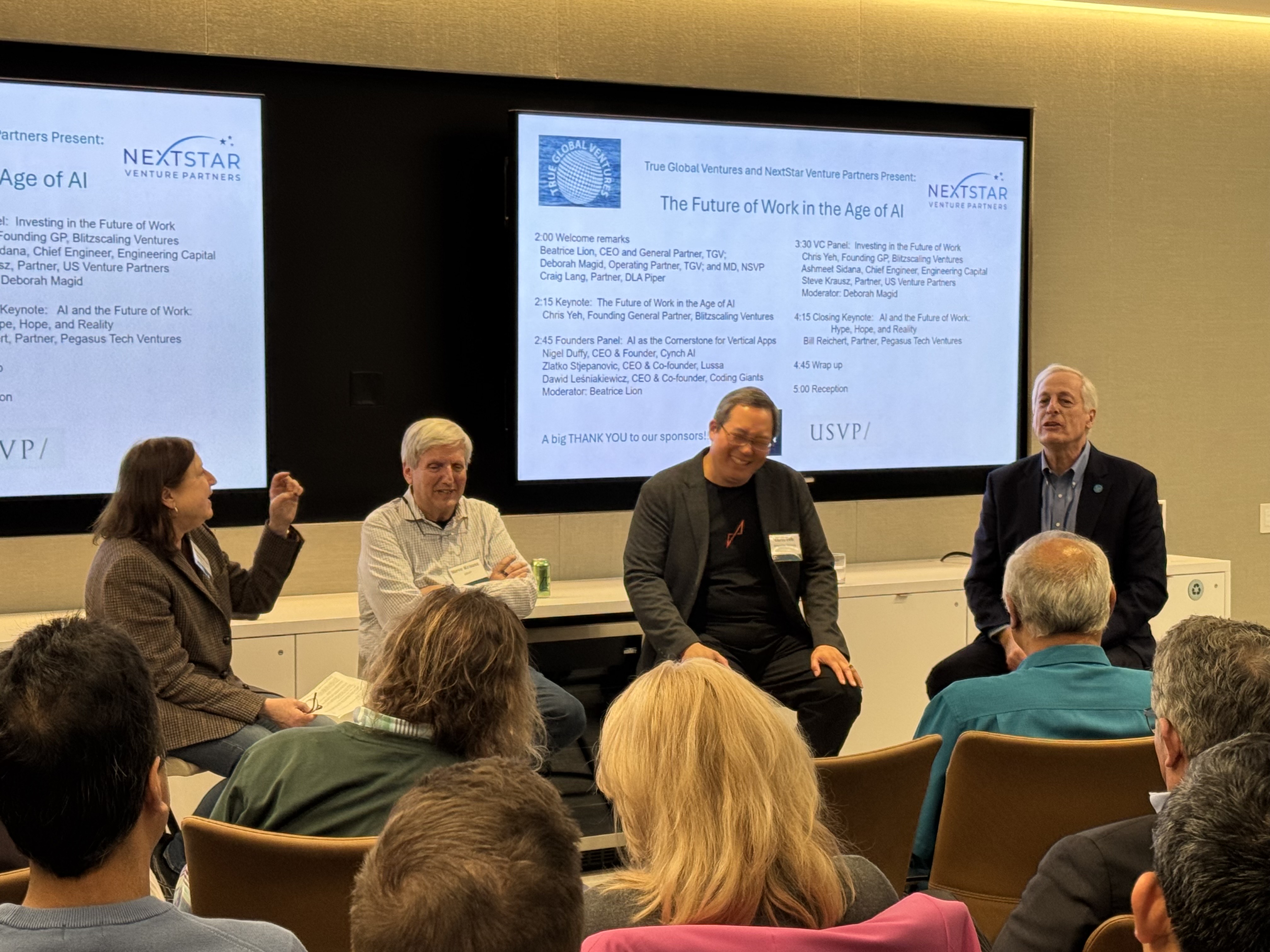
Surprisingly, most panelists agreed that AI can make our jobs harder. This is partially because it offers unique insights which might take a company in a new or difficult direction. Furthermore, it’s more important than ever to hire very smart people to manage AI’s power. 

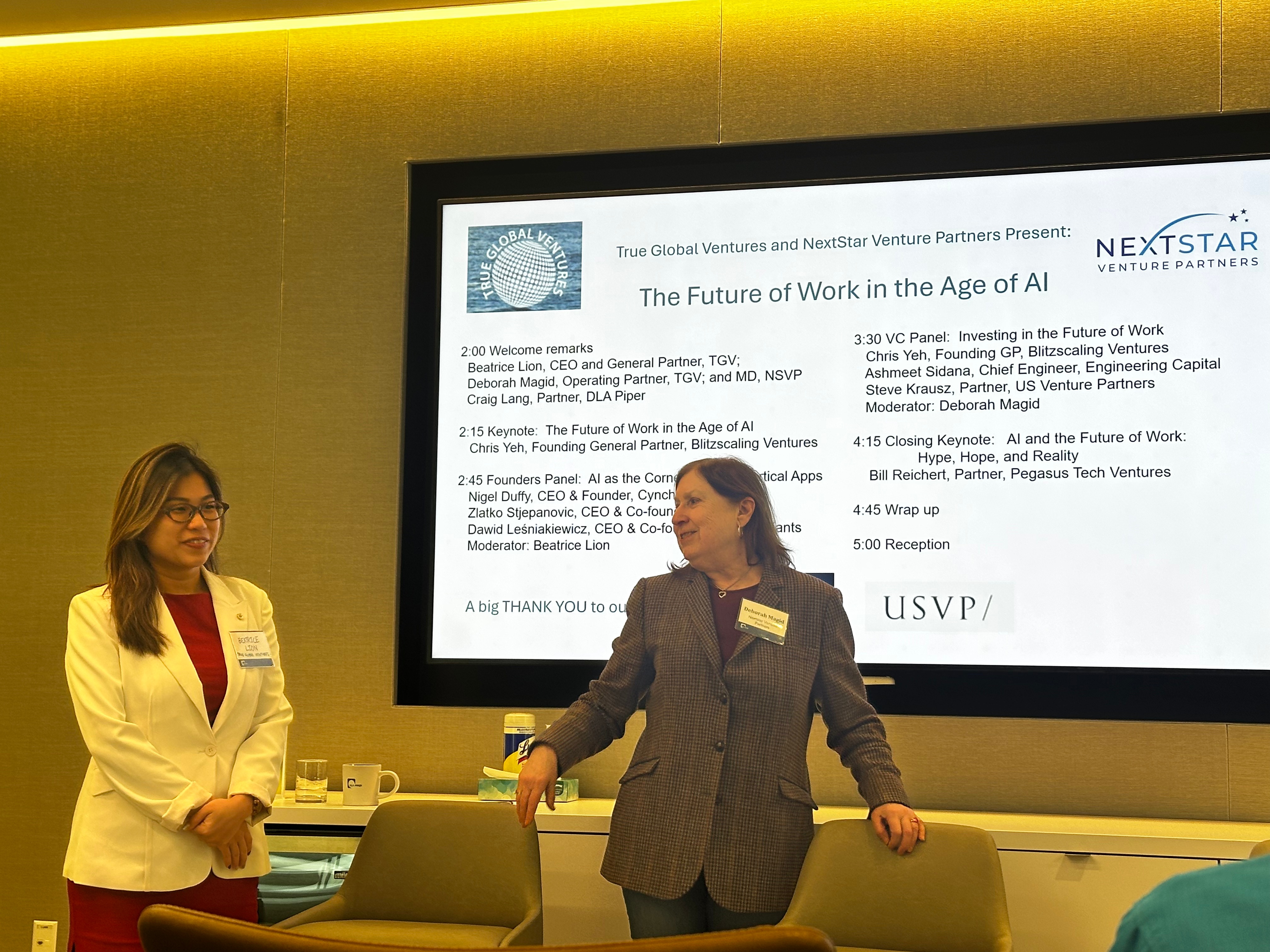
As background, panel moderator Deb Magid cofounded NextStar Venture Partners and helps run operations at global VC powerhouse TGV. Beatrice Lion TGV’s CEO  ran her own startup panel discussion with Coding Giants, Cynch AI and Lussa during the event. Those founders discussed AI in education, tax prep and gaming.
On her panel, Magid interviewed three VCs: Chris Yeh of Blitzscaling Ventures, who cowrote the book “Blitzscaling” with Reid Hoffman, Bill Reichert head of Pegasus Tech Ventures, formerly of Garage Tech Ventures, and Steve Krausz, one of the heads of U.S. Venture Partners.

Pegasus’s home page lists investments in Anthropic, Airbnb, SpaceX, and OpenAI. 

Here are some of their comments which include the type of companies they like to work with.

Since the theme of the day was AI and Future of Work, Deborah Magid asked them to comment on the statement, “AI will not replace employees. Someone using AI will.”

Reichert said that AI has done more “slowing of recruiting” than direct replacing. He said that sometimes companies use AI as an excuse for their lay offs.  

Steve Krausz then pivoted by bringing up the good that AI does. He mentioned backing both security and healthcare IT companies. He touted major advances in patient recovery related to AI innovation.

Chris Yeh then commented on what VCs invest in. He said, “Do we invest in something that is hot, or something valuable?”  Yeh said overwhelmingly he prefers something that solves a problem so valuable. He mentioned sometimes you pick a great solution but are too early. 

The panelists agreed that timing is everything. 

Steve Krausz brought up one that USVP backs called Quantifind saying that they started out focusing on advertising and then switched to financial services. To me this means that a VC can add great value. 

Krausz of USVP kept stressing a simple concept, “Address a problem that has not been solved.”

Reichert of Pegasus Tech added that they ask, what does a startup have that no one else has? And is it a defensible proposition? 

He says they look for things that are incredibly compelling. 

Chris Yeh of Blitzcaling added that they ask, how does a product or service remove friction in your life?

Each panelist commented that AI absolutely needs smart humans to get the most out of it. 

One said you may need to hire different people who know how to use and manage AI. Panelists oddly seem to agree that AI can make our work lives harder, not easier. 

It’s partially because AI can give you information that’s a new thought. This may make us think differently or take a new path. One panelist said AI isn’t supposed to just give you a standard research report. It’s supposed to supply a new perspective. 
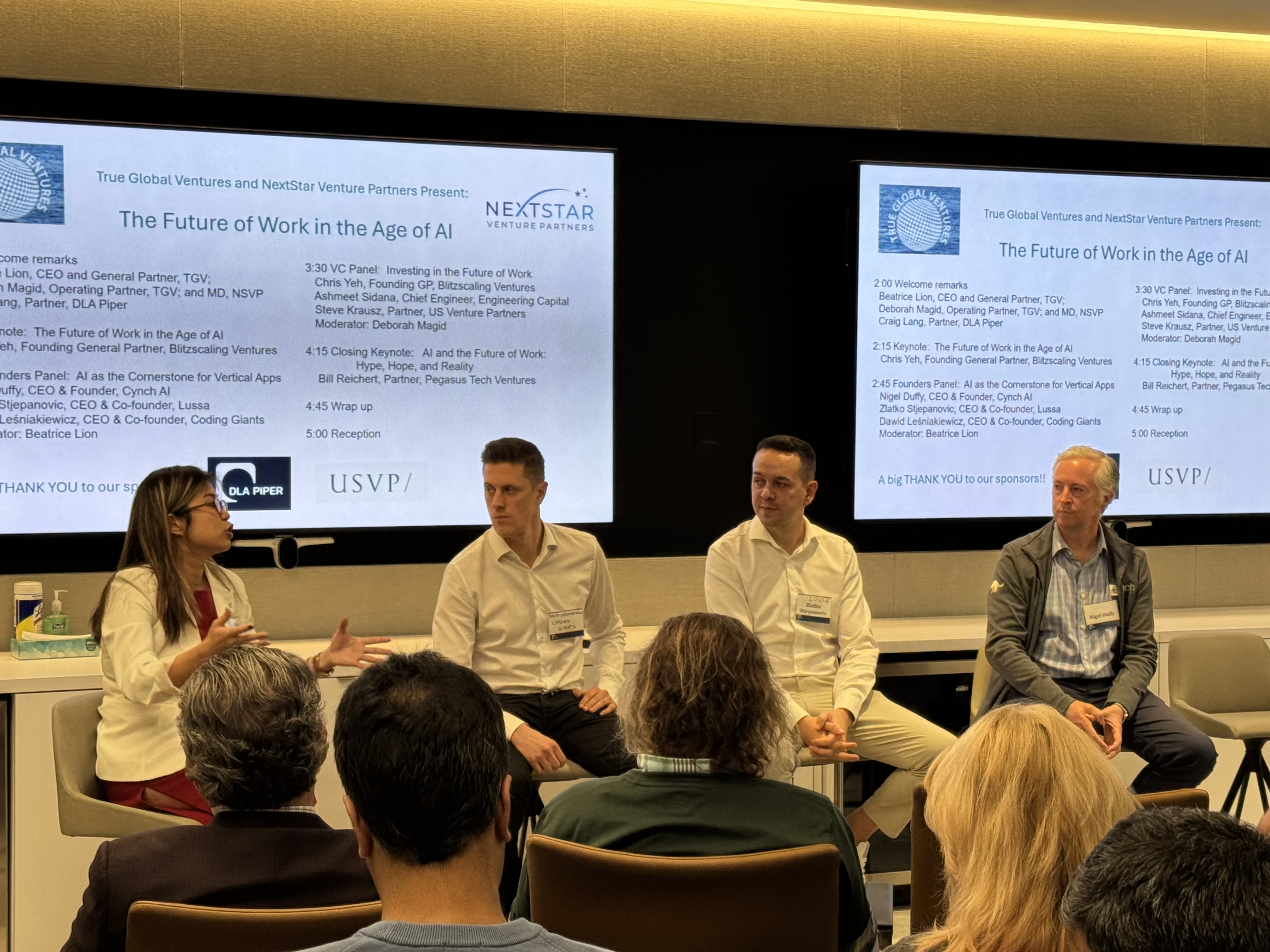
On the startup panel run by Beatrice Lion, Coding Giants co-founder Dawid Lesniakiewicz said that they teach kids coding but also have hundreds of teachers helping the learning process. Dawid said that we absolutely need excellent teachers and mentors to help with the AI-based learning process. 

Chris Yeh also gave a separate talk on investing and AI’s impact and said that only 3% of people use AI. As a wise PR professional who questions everything, I asked him for clarification out in the hallway: I told him it’s probably higher because of how many people use AI without knowing it, like iPhones with Siri, Google Maps and Microsoft Word. 

He said that 3% was a guess. Yeh is an expert on this topic so his guess does count.

On the other hand, I’m an expert too (a ranked future of recruiting influencer) and I’d say it’s well over 20 percent. At some point I’m going to do the math on this topic. 

On a final note, the trend and advice comments from every speaker were super informative and I was grateful to have the chance to hear from these experienced VC rockstars and smart founders.

Thank you to Deb Magid and Beatrice Lion for hosting this, and Deb for the invite! 

###

Michelle McIntyre, an award-winning IBM vet, is a tech PR consultant who garners much needed attention for startups and their investors. She’s a ranked Future of Recruitment influencer, has 3.2 million Quora views for her advice about elite college admissions, and was recently on PRSA Silicon Valley’s board of directors.

Photo credits: Michelle took two photos. One features Deb Magid and Beatrice Lion and the other is of the architecture. Adam (Hua) Chen, senior software director, Xingtera, took the panel photos.

Here’s part of the original Jan. 27th event agenda so readers can see all of the speaker names:

​2:15 Keynote:  The Future of Work in the Age of AI

​Chris Yeh, Founding General Partner and Author, Blitzscaling Ventures

​2:45 Founders Panel:  AI as the Cornerstone for Vertical Applications

​Nigel Duffy, CEO & Founder, Cynch AI (AI + Tax)

​Zlatko Stjepanovic, CEO & Co-founder, Lussa (AI + Gaming) 

​Dawid Leśniakiewicz, CEO & Co-founder, Coding Giants (AI + Education)

​Moderated by Beatrice Lion, CEO and General Partner, True Global Ventures

​3:30 VC Panel:  Investing in the Future of Work

​Chris Yeh, Founding General Partner and Author, Blitzscaling Ventures

​*Ashmeet Sidana, Founding General Partner and Chief Engineer, Engineering Capital *Author note: Sidana ended up not on the panel. Bill Reichert was added to the panel.

​Steve Krausz, Partner, US Venture Partners

​Moderated by Deborah Magid, Operating Partner, TGV; and Managing Director, NextStar Venture Partners

​4:15 Closing Keynote:   AI and the Future of Work:  Hype, Hope, and Reality

​Bill Reichert, Partner, Pegasus Tech Ventures

the end

Make Boosting Your Self Confidence A New Year’s Resolution

Confidence can be the difference between a startup’s or let’s face it any company’s success. Coming off a year of pandemic-related marketing woes like on my end, the cancellation of key conferences and the inability to schmooze over fancy dinners or coffee, how does a founder keep a winning attitude?

And is confidence the key to making it in 2021?

Experts say, yes, confidence is a key factor.

Confidence means security which leads to positive emotion: This results in better performance, says Tony Schwartz, the CEO of The Energy Project and the author of Be Excellent at Anything: The Four Keys to Transforming the Way We Work and Live. 

Schwartz, as quoted in a Harvard Business Review story, concludes that “insecurity plagues consciously or subconsciously every human being I’ve met.”

When I Googled the topic, “How to boost self-confidence” I uncovered a multitude of examples of admired well-known people who overcame their self-doubt.

Notable ones are John Steinbeck who sometimes thought his writing stank, Michelangelo who at first refused the Pope’s job offer to paint the Sistine Chapel due to not believing in himself and Abraham Lincoln who suffered bouts of depression. (Who knew?)

Michelangelo originally turned down the Pope’s job offer to paint the Sistine Chapel due to not believing in his own painting skills. Credit: Wikipedia Commons

They each ended up throwing themselves into their work to counteract these negative thoughts. And look where that landed them in history. On several “top of their game” lists, like favorite U.S. president.

We as entrepreneurs and business people can learn from these examples.

I’ve been taking note of solid advice from others involved in entrepreneurship to accommodate my entry into 2021 as a strong self-employed public relations consultant.

The first tip I latched onto as a new year mantra was from Thomas Ahn, founder and CEO of MAD Ventures of Victoria, British Columbia. MAD backs startups like artificial intelligence darling Layer 6.

At a founder round table discussion, when asked about his vision for the new year Mr. Ahn said his firm excelled at remote work before the pandemic. He said they’ll keep doing what they already do well, which I see as attracting and backing hot startups remotely, and do it with confidence.

For some reason the confidence part of his comment stuck with me in a big way.

I’ll add the tip to do more of something that you do well in 2021. Like if you are great at garnering attention via content marketing – like blogging to get your name out there – publish more blogs. That’s not to say spend more time on the task. Instead work smarter and not harder, like switch from 1,000 to 300-word stories.

C.J. Lipe, founder of Adminologist of Fremont, Calif., adds jump into 2021 with a positive attitude and set smart, measurable time-bound goals. Ms. Lipe says she finds her inspiration in affirmations and lectures found on YouTube.

Lastly, many news articles, for example, in Inc. said improving your style through a hair cut or a new outfit is a confidence booster, as is helping others.

In summary utilize a new confidence boosting tactic in 2021 and enjoy the business rewards that will result. Don’t fall into the sadness trap that has plagued many during these trying times.

##

Michelle McIntyre is an award-winning freelance PR consultant, social media influencer and IBM vet based in the Silicon Valley. She enjoys sharing advice, from how to get your small business media coverage to gaining admission to elite colleges via social media. She boasts 485,000 views on Quora as of early January 2021. She’s @FromMichelle on Twitter.

Crowdfunding Secrets Indiegogo and Kickstarter May not Divulge

By Michelle McIntyre

Image
I recently met an entrepreneur named Kitae Kwon who had raised $84,000 three years ago on Kickstarter for his unique docking station called Landing Zone.

This is pretty amazing considering the average amount raised is around $5,000.

There are some other exceptions.

Scanadu, maker of the super cool Scandadu Scout personal health monitoring device, raised more than $1.6 million using Indiegogo.

If you are not that familiar with the concept, here is the definition:
Crowd funding or crowdfunding (alternately crowd financing, equity crowdfunding, or hyper funding) describes the collective effort of individuals who network and pool their resources, usually via the Internet, to support efforts initiated by other people or organizations. Crowd funding is used in support of a wide variety of activities, including disaster relief, citizen journalism, support of artists by fans, political campaigns, startup company funding, movie or free software development, and scientific research. (Source: Mashable.com)

From a technology perspective, usually people who sign up to use the crowdfunding services of say a Kickstarter or Indiegogo ask for monetary donations, not for equity in the company, and in return, send donors a gift. It’s usually their product.

It’s nice because it forces the founder to get his or her marketing act together. This could mean getting professional photos and videos made or simply writing sales messages.

It could also mean a slew of new customers, if the donor gift is in fact the product.

The third benefit is that it’s organized way for friends, families and of course, new contacts to donate to your company.

Crowdfunding typically works better for B2C products by the way. B2B’s should probably just tap angel investor friends directly for funds.
There are some downsides though. Kitae Kwon says watch out for people who make your product look bad by posting terrible reviews which can often be fake. For example, someone posts a negative review before actually receiving the product.

Kwon said they probably come from competitors or random people who just like to write bad reviews.

He added that you have to be strong and confident when crowdfunding. If it doesn’t go as planned, your company could still be successful. Sometimes the campaign was just not planned or executed well.

Additionally, said Kwon, you could have a successful crowdfunding campaign but the product fails.

The net is, says Kwon, don’t let the campaign define your startup’s future.

However, Kwon adds, there are many crowdfunding benefits. For example, when people donate to get your product as a gift, it shows a bigger prospective investor, like a venture capitalist it is in demand.

Since he raised $84,000 for his docking station for the Apple Macbook Air, which is 10 times the average amount raised, Kwon must have had a huge demand.

For more unique crowdfunding examples, check out this story on the website Hooked on Social Networking. For information about Kwon’s company Landing Zone, visit: http://landingzone.net/
###
Michelle McIntyre is the president of MMC high tech PR, on the TEDxSanJoseCA executive team, and director of marketing communications for SVIABC. Follow her on Twitter at @FromMichelle  [Photo credit: iStockPhoto.com.]


Guy Kawasaki says Entrepreneurs Make these Top 10 Mistakes

ImageGuy Kawasaki spoke at The Startup Conference this week. (Photo credit: Guy Kawasaki)

By Michelle McIntyre

Investor, TED Speaker, startup expert, former Apple evangelist and author of nine books, Guy Kawasaki gave a talk called “The Top 10 Mistakes Entrepreneurs Make” at The Startup Conference in Redwood City, Calif., Wednesday. He is currently chief evangelist of Canva, an online graphic design tool.

Kawasaki has a BA from Stanford University and an MBA from UCLA as well as an honorary doctorate from Babson College.

As a PR and business strategy consultant to many startups, nothing he said shocked or amazed me but his side comments and answers to audience were very funny. He has always had a way of giving business advice in an entertaining and highly digestible fashion.

Here is his list of 10 top entrepreneur mistakes:

Mistake 1 Multiply big numbers by one percent to calculate market size.

Solution: Entrepreneurs should calculate from the bottom up and have realistic expectations.

Mistake 2 Scale too fast.

Solution: “Eat what you kill.”

Mistake 3 Form partnerships, or just focus too much on them.

Solution: Focus on sales. Kawasaki says, “Sales ‘fixes’ everything!”

Mistake 4 Focus on the pitch.

Solution: Focus on the prototype. Code writing software is more important than Microsoft PowerPoint.

Mistake 5 Use too many slides.

Solution: Use the 10-20-30 rule. It is 10 slides or less, 20 minutes in length and no smaller than 30 point type. I agree with this. In fact, I tell clients no more than six slides.

Mistake 6 Make serial progress.

Solution: make “parallel progress.” Startups need to multitask and be flexible instead of deciding that everything must be done in an exact order.

Mistake 7 Try to retain control. It’s a mistake to think that if you own 51% of the company, you can call all of the shots. Most decisions voted on in the board room are decided ahead of time.

Solution: Instead of focusing on how much of pie you have, focus on “making a bigger pie.”

Mistake 8 Use patents for defensibility.

Solution: Use success. He cautioned against mentioning patents more than once in a pitch.

Mistake 9 Hire in your own image.

Solution: Hire to complement. If you are a male founder, look for a female to round out the management team. Diversity is good for business.

Mistake 10 Befriend your investors.

Solution: Simply exceed expectations.

ImageEnchantment is one of nine books by Guy Kawasaki. (Photo credit: Guy Kawasaki)

My key takeaway was that early stage startups need to make their top two priorities developing a quality product and building the user base. Nothing else is as important.

###
Michelle McIntyre, @FromMichelle, is a PR consultant for tech startups, an IBM vet, on the executive team for TEDxSanJoseCA and director with Silicon Valley International Association of Business Communicators.