Listen Up, AI Startup Founders! VC Legends Offer Valuable Tips at Mixer 

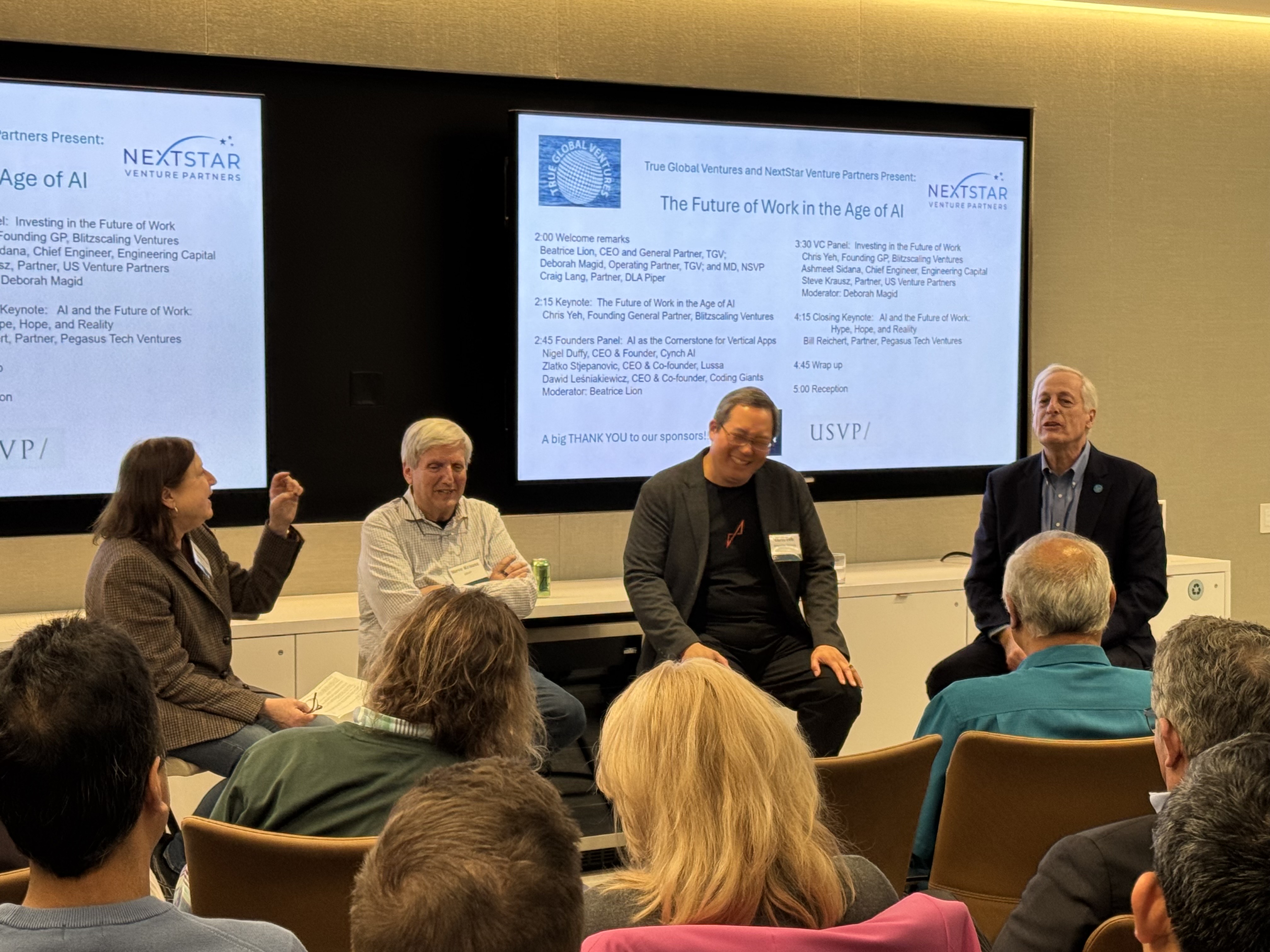
Venture Capitalist Deborah (Deb) Magid, my former IBM VC Group coworker, hosted a VC rockstars discussion at an AI and Future of Work event at DLA Piper law firm in Palo Alto on Tuesday. 

The comment highlighted repeatedly was that AI needs human guidance to work to its potential. 

Surprisingly, most panelists agreed that AI can make our jobs harder. This is partially because it offers unique insights which might take a company in a new or difficult direction. Furthermore, it’s more important than ever to hire very smart people to manage AI’s power. 

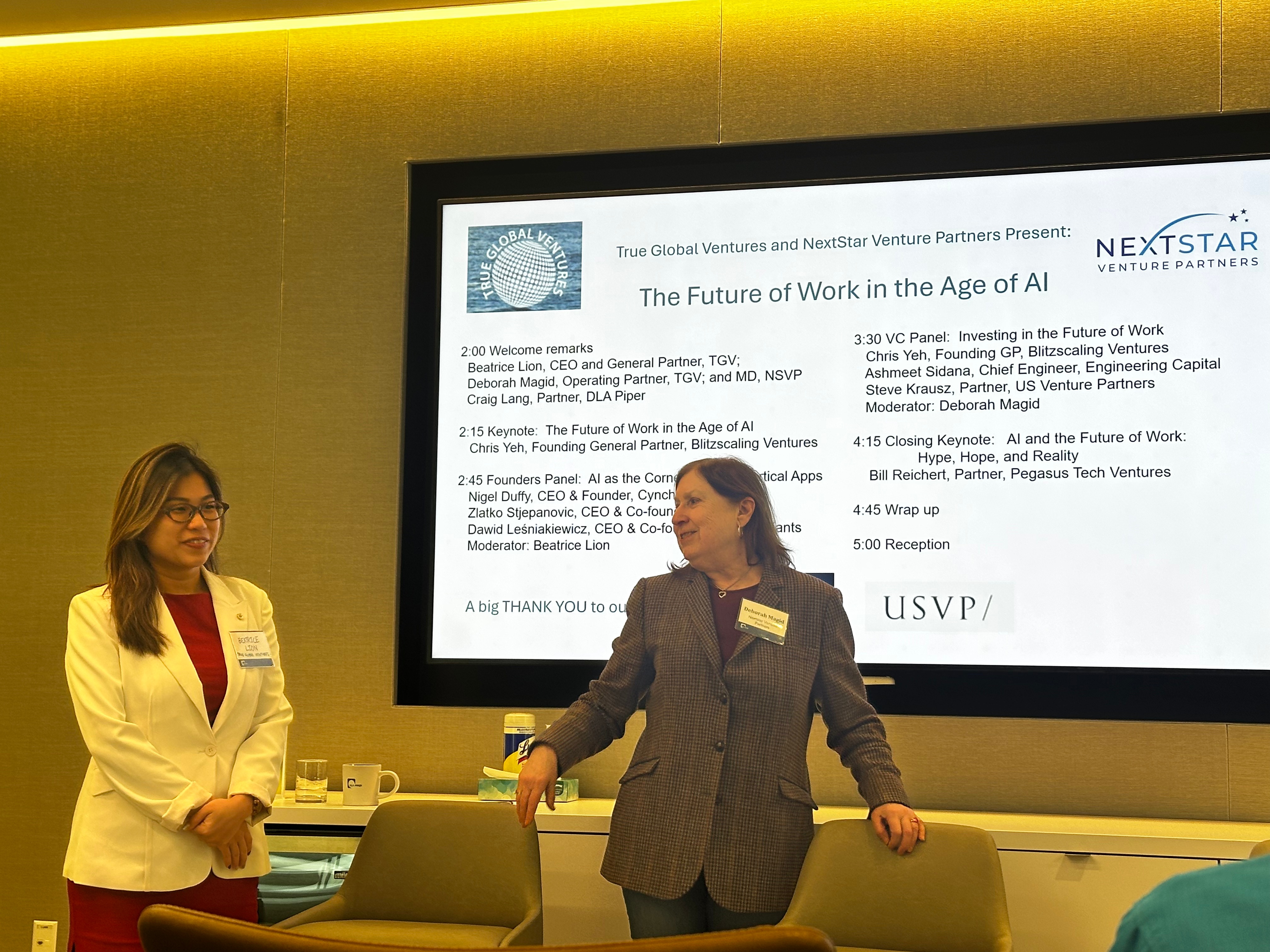
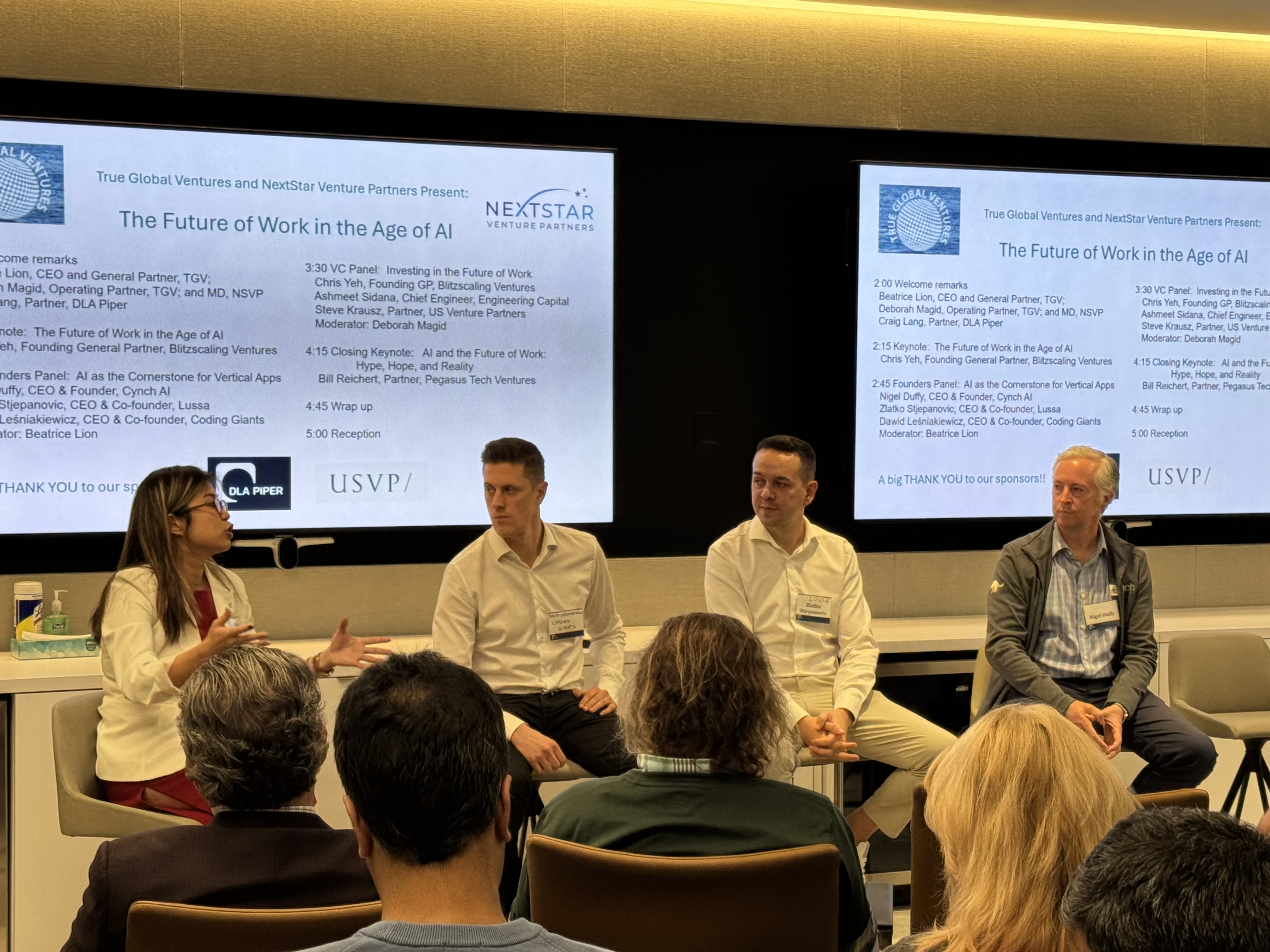
As background, panel moderator Deb Magid cofounded NextStar Venture Partners and helps run operations at global VC powerhouse TGV. Beatrice Lion TGV’s CEO  ran her own startup panel discussion with Coding Giants, Cynch AI and Lussa during the event. Those founders discussed AI in education, tax prep and gaming.

On her panel, Magid interviewed three VCs: Chris Yeh of Blitzscaling Ventures, who cowrote the book “Blitzscaling” with Reid Hoffman, Bill Reichert head of Pegasus Tech Ventures, formerly of Garage Tech Ventures, and Steve Krausz, one of the heads of U.S. Venture Partners.

Pegasus’s home page lists investments in Anthropic, Airbnb, SpaceX, and OpenAI. 

Here are some of their comments which include the type of companies they like to work with.

Since the theme of the day was AI and Future of Work, Deborah Magid asked them to comment on the statement, “AI will not replace employees. Someone using AI will.”

Reichert said that AI has done more “slowing of recruiting” than direct replacing. He said that sometimes companies use AI as an excuse for their lay offs.  

Steve Krausz then pivoted by bringing up the good that AI does. He mentioned backing both security and healthcare IT companies. He touted major advances in patient recovery related to AI innovation.

Chris Yeh then commented on what VCs invest in. He said, “Do we invest in something that is hot, or something valuable?”  Yeh said overwhelmingly he prefers something that solves a problem so valuable. He mentioned sometimes you pick a great solution but are too early. 

The panelists agreed that timing is everything. 

Steve Krausz brought up one that USVP backs called Quantifind saying that they started out focusing on advertising and then switched to financial services. To me this means that a VC can add great value. 

Krausz of USVP kept stressing a simple concept, “Address a problem that has not been solved.”

Reichert of Pegasus Tech added that they ask, what does a startup have that no one else has? And is it a defensible proposition? 

He says they look for things that are incredibly compelling. 

Chris Yeh of Blitzcaling added that they ask, how does a product or service remove friction in your life?

Each panelist commented that AI absolutely needs smart humans to get the most out of it. 

One said you may need to hire different people who know how to use and manage AI. Panelists oddly seem to agree that AI can make our work lives harder, not easier. 

It’s partially because AI can give you information that’s a new thought. This may make us think differently or take a new path. One panelist said AI isn’t supposed to just give you a standard research report. It’s supposed to supply a new perspective. 

On the startup panel run by Beatrice Lion, Coding Giants co-founder Dawid Lesniakiewicz said that they teach kids coding but also have hundreds of teachers helping the learning process. Dawid said that we absolutely need excellent teachers and mentors to help with the AI-based learning process. 

Chris Yeh also gave a separate talk on investing and AI’s impact and said that only 3% of people use AI. As a wise PR professional who questions everything, I asked him for clarification out in the hallway: I told him it’s probably higher because of how many people use AI without knowing it, like iPhones with Siri, Google Maps and Microsoft Word. 

He said that 3% was a guess. Yeh is an expert on this topic so his guess does count.

On the other hand, I’m an expert too (a ranked future of recruiting influencer) and I’d say it’s well over 20 percent. At some point I’m going to do the math on this topic. 

On a final note, the trend and advice comments from every speaker were super informative and I was grateful to have the chance to hear from these experienced VC rockstars and smart founders.

Thank you to Deb Magid and Beatrice Lion for hosting this, and Deb for the invite! 

###

Michelle McIntyre, an award-winning IBM vet, is a tech PR consultant who garners much needed attention for startups and their investors. She’s a ranked Future of Recruitment influencer, has 3.2 million Quora views for her advice about elite college admissions, and was recently on PRSA Silicon Valley’s board of directors.

Photo credits: Michelle took two photos. One features Deb Magid and Beatrice Lion and the other is of the architecture. Adam (Hua) Chen, senior software director, Xingtera, took the panel photos.

Here’s part of the original Jan. 27th event agenda so readers can see all of the speaker names:

​2:15 Keynote:  The Future of Work in the Age of AI

​Chris Yeh, Founding General Partner and Author, Blitzscaling Ventures

​2:45 Founders Panel:  AI as the Cornerstone for Vertical Applications

​Nigel Duffy, CEO & Founder, Cynch AI (AI + Tax)

​Zlatko Stjepanovic, CEO & Co-founder, Lussa (AI + Gaming) 

​Dawid Leśniakiewicz, CEO & Co-founder, Coding Giants (AI + Education)

​Moderated by Beatrice Lion, CEO and General Partner, True Global Ventures

​3:30 VC Panel:  Investing in the Future of Work

​Chris Yeh, Founding General Partner and Author, Blitzscaling Ventures

​*Ashmeet Sidana, Founding General Partner and Chief Engineer, Engineering Capital *Author note: Sidana ended up not on the panel. Bill Reichert was added to the panel.

​Steve Krausz, Partner, US Venture Partners

​Moderated by Deborah Magid, Operating Partner, TGV; and Managing Director, NextStar Venture Partners

​4:15 Closing Keynote:   AI and the Future of Work:  Hype, Hope, and Reality

​Bill Reichert, Partner, Pegasus Tech Ventures

the end

Want Press Coverage? Do Your Homework

Jon Arnold is a long-time independent industry analyst, and his boutique analyst firm, J Arnold & Associates, focuses on communications and unified communications.

Mr. Arnold, who has his own newsletter and Future of Work podcast called “Watch this Space,” writes for and is quoted by the likes of No Jitter and is speaking at Enterprise Connect on March 21.

Even though his primary role is as an analyst, the other day he inadvertently offered me some media relations tips.

First Mr. Arnold complained that often PR people find him on a media list and pitch him without doing their homework. “They just send the same pitch to the full list,” says Mr. Arnold, “assuming they’re all journalists writing news stories.” While he does write regularly about the industry, they are thought leadership analyses rather than journalistic reporting on news of the day.

“Since most PR people won’t ever get to my website to review my work, this important distinction will never be understood, leading only to wasted time at both ends. If instead, they did their homework, they would know better.”  The end result is usually a curt reply from Jon Arnold, followed by an I-should-have-known-better apology from the agency.

I did comment to him that the line has blurred between analyst and journalist. It is confusing, even to seasoned folks. 

He said he can tell when they have no idea that he’s an analyst which frustrates him.

Another thought he added had to do with timeliness. He said journalists quote him in stories because he is able to get back to them by 5 pm the same day. Bingo. He said the words that I have heard over and over. Journalists often need comments the same day. And he obviously knows how to help journalists within their tight deadlines. He’s quoted widely on important industry news like mergers and acquisitions. 

Therefore, to be a super media relations professional, try to have both the reporter and executive on speed dial.

How do you know what they might ask? Ask yourself, what is making headlines? Right now, I expect journalists to ask, do you have employees, customers, or suppliers in Russia or Ukraine? What’s your pandemic or endemic work policy? Also, if you are in certain fields, prepare your answers before you are asked or asked again. Like if you are in fintech, be able to answer questions about the crypto market.

If you are in the collaboration space, prepare an answer so you are ready when asked by a journalist about conducting business in the metaverse

Independent versus Large Analyst Firms

During the conversation Mr. Arnold told me the key differences between large and boutique analyst firms. Formerly with Frost & Sullivan, he said the big firms will offer large reports, rankings and awards.

As an independent analyst, Jon Arnold does not do awards. He is paid by vendors to speak at events and write white papers and trend reports. Sometimes he is asked to rewrite a report that an engineer wrote, so it is palatable to key constituents. Topics might relate to things like hybrid work, artificial intelligence-enabled technologies, doing business in the metaverse or Web 3.0, unified communications and contact centers. I noticed Mr. Arnold was quoted in stories about the failed Zoom Five9 acquisition. 

In summary, do your homework on a writer before you pitch and figure out a way to get them a response the same day. Also, if you are pitching an analyst be careful what you say when you reach out, if at all. [Photo credit: Jon Arnold]

###

Michelle McIntyre is a freelance public relations professional and future of work microinfluencer. Follow her on Twitter @fromMichelle. Jon Arnold’s Twitter profile is @arnoldjon. He’s also a future of work influencer. Chris Fine co-hosts the Watch this Space podcast with Jon Arnold.

I’ve Been A Remote Worker for 20 Years: Here’s A Prediction

It’s interesting to hear everyone go ga ga over doing a Zoom business meeting or cocktail party. To me online meetings are no big deal and after many meetings from my home office for the past 20 years, I’d rather just make a phone call. People are inviting me to meet via Zoom as if it’s super special or a game or something. I appreciate it but it’s not special or fun to me. It’s business as usual. I’m not going to glamorize it. And be careful what you talk about using the free services. Your security may not be so good unless you pay for a pro version.

shutterstock_1684211233

However, regarding birthday celebrations, yes, it is a nice gesture to see everyone’s faces on the screen. That’s different and is nice if you live in different countries or states. I would rather see the “drive by parades” instead if your buddies are close enough to do that.

I’ve been a remote worker both for IBM and for myself for the most part since 2000 when my son was born. He is finishing up his freshman year at University of California Berkeley right now. He turns 20 this year. He’s been around as long as I’ve been a remote worker!

I say I worked from home “for the most part” because when I was West region PR manager for  IBM I had a sweet office in Mountain View, which I think is now owned by Google, as well as a guest office at IBM Almaden Research Center. But I mainly worked at home. And by the way my son went to daycare while I did that. It would have been a bit dangerous for him to wander around the house as a baby or toddler during my super busy IBM days.  (Remote work parents of toddlers: be careful.)

Here’s my prediction about what’s going to happen: in the next 18 months we will all need to be able to turn on and off remote work. I don’t believe everyone will “turn remote” permanently though. I think schools will still be around. Offices and work buildings will still be around. So don’t get rid of your printer-copiers, desks or chairs.

After listening to numerous interviews with medical doctors and data scientists from places including Columbia and UC Berkeley, I have a strong opinion about what might happen.  I believe that almost all businesses will have both an in person and remote work option.

During the next year people will go back to school and to the office. But at some point, they will told to go back home. For example, they could go back to school and work in August but be called back home for a few months in December or February. These are made up months: the exact day will depend on what happens with the COVID-19 curve. But a UC Berkeley PhD said today during an online teleconference that COVID cases could very well start to increase again during flu season: that’s when people may be called home again.

Whether students and workers go out or go home will depend on if people are getting sick from something that isn’t very treatable. So if the COVID-19 numbers go up we go home. They go down, we go to the office. Therefore my prediction is that we’ll have this back and forth lifestyle for at least one and a half years. Then maybe there will be a vaccine and things might go back to normal again.

What problems will occur? This will put more stress on college students who go to schools far away from their parents’ homes. They have to decide, will they stay at their college apartment when they get called back to online school or move out and go to mom and dad’s? Will landlords give students a break if they move out back home for three months? One of more vocal parents from the UC Berkeley Cal Parents Discussion Group Facebook page suggested simply asking landlords to put a special clause into the leases. If you move out, maybe you can get a break that month.

Regarding K-12, poorer kids will need to get laptops and WiFi supplied to them. One school district representative from New York said just this week that around 20% of their K-12 school children don’t have technology or bandwidth at home for online learning. And they have figured out how to solve about 10 percent of this problem but are working on the rest of it. Business, schools and communities: let’s work on solving this digital divide problem as a team.

My advice is simple: go with the flow and stay flexible. Flexibility is the name of the game moving forward. But wait, there’s more.

Help someone and you will get a favor back at some point: I’ve already experienced that. I bought hand sanitizer for a stranger and got a much needed essential item literally gifted to me soon after.

Try to stay healthy because if you get sick you will recover faster.

Good luck and happy online meetings everyone. I wish you all long lives with much toilet paper. And sorry if I missed your fun Zoom party. It reminds me too much of work.

###

Michelle McIntyre is the founder of Michelle McIntyre Communications LLC, a tech PR consulting firm in Saratoga, Calif. She’s an IBM vet and also a future of work influencer. Follow her @FromMichelle on Twitter.