Unknown's avatar

About Michelle McIntyre

Silicon Valley PR Consultant

Six Tips on How to get Funded from the Queen of Venture Capital

Image

Venture capitalist Ann Winblad recently spoke to our Women Startup Lab Meetup group in Menlo Park.

Winblad is the co-founder and a Managing Director of Hummer Winblad Venture Partners. With over 30 years of experience in the software industry she is a well-known and respected entrepreneur and technology leader. She is also on the board of directors of SVForum.

She has a slew of impressive degrees and credentials and founded a software company in the mid-80s which was acquired back before software was hot.  I used to work with Winblad when I was with IBM Venture Capital Group and it great catching up with her again before her talk to about 30 female entrepreneurs.

Today software is not just hot. It’s white hot. Large companies like IBM have shifted their focuses from hardware to software in recent years. In fact last I checked software was IBM’s most profitable group.

Winblad estimates that today 60 percent of companies that receive VC-funding offer software.

Hummer Winblad Venture Partners was founded in 1989 as the first venture capital fund to invest exclusively in software companies.

My key take-away from Ann Winblad’s talk was that she doesn’t like to invest in entrepreneurs who focus on risk.

The word “risk,” says Winblad, has a negative connotation. It is associated with the threat of failure and impossibility.

Winblad instead likes to invest in companies run by opportunists and visionaries.  She looks for company leaders with can-do attitudes who look toward the long-term goal. She says companies that IPO are on average seven years old and ones that are acquired are at least 10 years old.

Here are her six tips on how to get funded. By the way, she stressed that her firm focuses on Series A funding, not seed funding.  This means funding a company and not just a concept.

1. DON’T BE A RISK TAKER. Focus on opportunity not risk. It’s not about being a risk taker; it’s about being a visionary.

2. KEEP AN EYE ON THE FUTURE. Winblad says it’s because visionaries are inspired, enterprising, and insightful.

3. SHOW HER YOU CAN ATTRACT TALENT. Do people want to work with you? Are you a team player? Attracting and retaining the best talent is what makes or breaks companies.

4. DON’T HAND HER A COMPANY PROFILE. E-mail her but only if it’s a fit. For example, don’t send her company information if she backs a competitor.

5. HANG OUT AND NETWORK WITH VCs. Half of the companies funded by VCs are Silicon Valley-based and 80 percent of the world’s VCs are based here as well.

6. WHEN PRESENTING, DON’T BE SO BUTTONED DOWN.  VCs invest in people with personalities and heart. This is especially a women’s problem. Don’t be so formal.

Here is a list of selected active and historical Hummer Winblad Venture Partner investments.

 Selected Current Companies:

AceMetrix
Aria

Domo

Baynote

Birst

Insidesales

Kiip

Flite

Infulitive

Karmasphere

Marketo

MuleSoft

Sonatype

Piston

Plumgrid

Voltage Security

And others


Historical:

Wind River

Hyperion

AdForce

Powersoft

Starmine

NetDynamics

Intrinsa

Krillion

Liquid Audio

Market Wire

Net Perceptions

Star Analytics

###

Visit https://plus.google.com/photos/111651143754275279070/albums/5924958611441888881 for photos of the event.

Michelle McIntyre is president and principal consultant at Michelle McIntyre Communications LLC, a high tech PR firm based in Saratoga, California. Follow her at @FromMichelle on Twitter. Women Startup Lab is @ws_lab.

Founder of DrinkDrop Finds Inspiration from Other Moms

Lisa Guyman, founder of DrinkDrop find other moms are supportive of her new business.

Lisa Guyman, founder of DrinkDrop finds other moms are supportive of her new business.

According to the State of Women-Owned Businesses Report, the number of businesses owned by women in the United States has gone up 59 percent since 1997. These companies generate $1.3 trillion in revenue and employ eight million people.

I looked up this statistic after noticing that a large number of women, particularly those with children, in my Silicon Valley neighborhood founded their own companies.

Parents Maitjian and husband Todd Welke started their IT services business CMIT Solutions of Southwest Silicon Valley three years ago.  Mom Nikki Brown has been a self-employed graphic designer and personal trainer for years. I have a son and started my high tech public relations consulting firm in January.

My next door neighbor Lisa Guyman has just jumped on the lady CEO bandwagon with her new company DrinkDrop (www.drink-drop.com) and she says the experience has been a good one.

“It’s been a lot of fun. I’ve had a lot of very positive feedback about our products, and I’ve been blown away with how supportive other moms have been. I think that’s the coolest part about being a female founder–the understanding from other women about the balance it takes to have a business and be a mom,” says Guyman.

A DrinkDrop is a frozen, two ounce individual size drink mix that contains whole fruits, vegetables, and herbs. Saratogans can purchase them at Gene’s Fine Foods.

Guyman says that all DrinkDrop mixes are designed to be combined with a particular liquor and club soda. A DrinkDrop cup is provided to measure the rest. The all natural drink concoctions are also good without alcohol, Guyman says.

Guyman says you can keep DrinkDrop mixes in your freezer, and when you feel like a drink, just drop one in your glass. In seconds, you’ll have an attractive and tasty specialty drink.

Her husband Jeff Guyman came up with the idea after the couple held a wedding reception in their Saratoga backyard for her brother and sister-in-law. They needed a way to serve special drinks to a large number of guests.

Lisa is keeping busy promoting her company. She recently hosted a tasting table at Gene’s Fine Foods. Distillery 209 of Pier 50 in San Francisco is sponsoring the next DrinkDrop tasting event at the San Francisco Ritz Carlton on Sunday, August 25. The details are on the DrinkDrop website.

Like other female CEOs, Lisa Guyman is master priority juggler. She and Jeff have a one year old son, three year old daughter, and two rambunctious and just as adorable chocolate Labrador Retrievers. She holds an undergraduate degree from University of California Berkeley and a doctorate in physical therapy from University California San Francisco. She also ran Cal Bear track.

Guyman says, “Raising kids is the hardest and best thing I’ve ever done, but I’ve always needed that something else. I’ve worked as a physical therapist for years, and I actually love being a physical therapist, but I’ve always wanted something that’s my own creation.”

Husband Jeff Guyman also has an impressive resume. He is a sales executive for a local power supply company and a Stanford University graduate who used to both swim and play water polo there. At one point he was ranked the number one water polo player in Washington State.

However, Lisa tells me that Jeff is totally focused on his 9 to 5 sales job so she started the company and handles the details herself. Due to the uniqueness and quality of her product, she is realizing that there is a lot to do to fill demand.

She elaborates on this point by saying, “These days, there is a big trend toward fresh herbal cocktails and mixology, or drinking your garden. We take all the work out of it and just say here, have a great cocktail and feel good about what you’re drinking.”

For additional information about trends in female leadership, read my review of the book Lean In: Women, Work and the Will to Lead here.

###

Note: This story was originally published in the Saratoga Patch community newspaper in August and as of today, it has received 146 likes on Facebook.

A popular drink drop option

This is what a DrinkDrop looks like. It’s quite small so you can fit a lot of them in a freezer.

An attractive and trendy DrinkDrop option

Hummingbird Nectar is a delicious, attractive and trendy DrinkDrop option.

8.20.13.2.Sueno

Timely PR Advice for BART Workers

A commuter at the BART Fremont station (Photo from iStockPhoto.com)

A commuter at the BART Fremont station (Photo from iStockPhoto.com)

I’m not taking sides in the fight between BART management and the BART union. As some of you know BART is a transit system that’s really popular here in the Bay Area. It gets people to work, school, events, shopping and other places. When I last took it, I was going to Golden State Warriors basketball game in Oakland. The Warriors won. It was a great night.

What’s happening now is that the BART union workers are threatening to strike unless they get an agreement for more pay and better benefits.

However, I’d say management is winning the publicity war so BART workers, step up your PR game a bit to get your point across better.

According to today’s San Jose Mercury News, BART union members argue that they are due a pay raise and haven’t had one in a few years. BART is doing well financially so they should be rewarded.

Management’s take on this is that the average blue collar BART worker makes $76,000. That’s a nice salary for someone who doesn’t need a college degree to get a job, even in the expensive Bay Area. So the PR team for management gets more points for getting this point across and in most stories I’ve heard or read about this issue.

I read an Op-Ed by a teacher a month ago who uses BART who made a lot less than the BART workers who might strike. She made at least $30,000 less than $76,000. She was furious that they were complaining about the high salary considering she had to get an undergraduate degree, master’s degree to do her job and, “Shame on them for complaining.” Her letter said she needed BART to get to work so, “Striking is bad,”

But then again, two wrongs don’t make a right. Just because teachers are underpaid, doesn’t meet hard working BART workers need to be underpaid.  When we took BART to the Warriors game, I noticed the workers did an awesome job so kudos to them.

I also heard a radio interview yesterday. A news talk show host was interviewing a BART worker who was fighting for better pay and benefits.  The worker who had a ton of time on air to say his peace could not articulate why they deserved more.

I was hoping to at least hear, “There’s a problem with the health insurance. Here’s what it is!” but no, all he did was complain endlessly about how goofy it was for someone PR person to make up that it costs $70 million when they walked off the job about a month ago.

He said, “That can’t be right. Who makes that stuff up?” Seriously, this is the union defense on a popular radio show? Most intelligent people can understand how much money a transit strike could cost the economy. I don’t need proof of the $70 million. In fact I could easily make a case that it’s higher.

I was really just trying to understand what’s so bad about the current package but instead they insulted people in my profession. Epic message fail on his part and waste of an interview to help the union’s case.

One reason BART management is doing better in the publicity wars is because of its great PR team.

So my advice to the soon-to-strike BART Workers is this.

Clearly articulate what is so unfair about your benefits package. Be very specific so that people understand with some proof and not just, “We need more.”

Make the message very short and add a number to it so that every media outlet picks it up, even in the shortest of stories. 

The net is quantify in a compelling manner to fight the “$76k for a blue collar worker” argument.

By the way, thanks for the nice ride to the Warriors game. BART rocks and keep up the great work.

###

Michelle McIntyre is the president of Michelle McIntyre Communications LLC, based in Saratoga, CA. She does PR for high tech start-ups headquartered in California and Europe and is also the director of marketing communications for the Silicon Valley International Association of Business Communicators, a non-profit that promotes ethical and quality communications.

3 Business Tips from Tim Draper, the VC who Backed Skype and Hotmail

Here are some business success tips from dynamic Venture Capitalist Tim Draper and founder and managing partner at Draper Fisher and Jurvetson (DFJ).

He spoke at my Women Startup Lab (http://www.meetup.com/WomenStartupLab/) Meetup last night at his incubator headquarters, Draper University in San Mateo.

According to a recent San Francisco Business Times story, per a 2010 study which was the most recent available at the time, only 1% of companies funded by VCs are women-owned so kudos to you if you go out of your way to encourage them. This includes Draper’s firm, Women Startup Lab Founder Ari Horie and Sponsor Procopio law firm.

I’m also doing my part to help female entrepreneurs. One of my favorite clients is Romanian-born Londoner Ozana Giusca, who recently launched Tooliers.com, which some call the “Accenture for small businesses.” I look forward to seeing this new self-service business consulting tool be wildly successful someday.

Here’s a recent clip of Ozana on SiliconAngle TV discussing European VC trends and self-consulting:

 http://www.youtube.com/watch?v=brSGZLNVYZs.

You may have also read about Ozana in the San Jose Mercury News feature story about SiliconHouse:

http://www.mercurynews.com/mike-cassidy/ci_23506448/cassidy-siliconhouse-hosts-worlds-entrepreneurs-business-building-crash

Now back to Draper’s talk . . .

If my mom in Cleveland is reading this, she is probably saying, who the heck is Tim Draper?

Well, mom, Tim Draper is a household name in the Silicon Valley having backed Skype, Hotmail e-mail, Baidu, Good, and numerous others. I first met him when we worked together supplying reporters with information about the VC industry overseas while I was with the venture division at a large corporation.

This article mostly focuses on his advice for women who want to start businesses. These three tips stuck with me:

TAKE OVER THE WORLD I believe this one has to do with attitude. Be a game changer. Think outside of the box. Disrupt the way of doing things. Aim high!

BE UNPOPULAR (if needed) One idea in Sheryl Sandberg’s book Lean-In which encourages women to be leaders is that women who are aggressive at work are sometimes unpopular while men who show the same “level of energy” are applauded.

GO BIG If you start a company, do it with passion and gusto. Be excited. Give it your all.

Draper has backed many successful female entrepreneurs including Robin Wolaner who started Parenting magazine and sold it to Time, Heidi Roizen of T/Maker who is now a DFJ partner, Beth Cross of Ariat, and several others.

Draper says VCs generally don’t care if you are a man or woman. He looks for entrepreneurs who are “extraordinary, driven and excited” who disrupt the normal way of doing things Tesla disrupted the automotive industry.ImageImageImage

The audience last night included both his Draper University incubator students and our Women Startup Lab Meetup group which encourages women to pursue their business dreams.

Ari Horie has done a fabulous job marketing Women Startup Lab which has grown to 430 women in a few short months.

###

Photo captions:

1. Tim Draper and Women Startup Lab Founder Ari Horie. Draper says that’s his “Wonder Woman” cape. Draper University sports a super hero theme.

2. Bean bags at Draper U.

3. Draper presents the industries ripe for disruption.

Michelle McIntyre is the president of Michelle McIntyre Communations LLC headquartered in the Silicon Valley. Her clients include early stage start ups and small businesses in California and Europe.

Working Moms: Read this if your Child is in Daycare this Summer

Lean-In by Sheryl Sandberg is on the bestsellers list at my local library this week.

Lean-In by Sheryl Sandberg is on the bestsellers list at my local library this week.

One thing about Sheryl Sandberg’s book “Lean-In: Women, Work and the Will to Lead” that hit home with me was the statistic she mentioned in the chapter “The Myth of Doing it All.”

The main message of the book says is that it’s okay and even recommended that women, if they choose, take their careers to the highest level.

She is frustrated that there are so few women at the upper level of companies. She says that women tend to have less confidence than men and are each perceived much differently in the workplace. One way is that women who are tough are seen as bitches while men who are aggressive are seen as awesome.

Sandberg is wicked smart and has had senior executive roles at successful companies like Facebook. She was in the right places at the right times but at the same time, she worked hard and seemed to have the right attitude in advancing her career, which she says sometimes meant moving sideways instead of up the ladder.

Let’s go back to the topic at hand — the point she makes about guilt and the working mom. I like this fact because for most of the past 12 years, my son has been in day care while my husband and I worked.

In 1991, the Early Child Care Research Network, under the management of the National Institute of Child Health and Human Development, studied 1,000 children over 15 years. In 2006, the researchers released a report summarizing their findings, which concluded that “children who were cared for exclusively by their mothers did not develop differently than those who were also cared for by others.”

Sandberg goes on in great detail about how it can hurt children when you feel guilty and show stress about leaving them in daycare.

The truth is that children are fine and can even thrive when they don’t have a stay at home mom. I have seen proof as well. My son is funny, smart, and mature and has his act together. I had a lot of help raising him from YMCA and Walden West camps in the summers, and from on-campus daycare programs during the school years. Not staying home to raise him 24/7 didn’t hurt him one bit.

My son is going to basketball camp this week but instead of feeling guilty about it, I’m taking Sandberg’s advice. I feel fine and look forward to a super productive week serving my clients.

Sandberg actually repeats the message in different ways but it seems she likes this statement the best.

“Exclusive maternal care was not related to better or worse outcomes for children. There is, thus, no reason for mothers to feel as though they are harming their children if they decide to work.”

Thanks, Sheryl Sandberg for writing this book that is way overdue for the working moms.

The book is available on the best sellers’ shelves20130619_193004 at the local libraries or at Amazon.com at http://www.amazon.com/Lean-In-Women-Work-Will/dp/0385349947/ref=sr_1_1?ie=UTF8&qid=1373246869&sr=8-1&keywords=sheryl+sandberg%E2%80%99s+lean+in

###

For Women Only! 5 Tips for Launching a Start-up from the Founder of Mightybell and Ning

Three businesspeople working on a touchpad.

I went to a unique women-only meet-up, or gathering of like-goaled individuals to swap ideas and network in what I call “VC country” – Menlo Park, California — the other day.

Venture capitalists like it because it’s close to both Stanford University and all of those hungry b-school grads who usually have the same three goals:

1. Change the world.

2. IPO or get acquired.

3. Make a boat load of cash.

Because VCs like the area, it’s a popular place to start a business, especially one focusing on technology due to it being on the north end of the Silicon Valley. The ecosystem here supports starting companies.

The fairly new meet-up group called Women Startup Lab (http://www.meetup.com/WomenStartupLab/) was founded by Ari Horie. Ari and I used to work at IBM together. Now we’ve both jumped into the entrepreneur pool. A whopping 300 people joined Ari’s group on-line in just 12 weeks. This shows there is a need for more groups that support women entrepreneurs.

Getting together with other women takes some of the gender-related issues away from the meeting. You don’t have to wonder, did he like or not like my idea because I’m a woman?

And because 80%+ new businesses fail, it’s wise to get as much advice as possible from successful entrepreneurs so you can increase your chances of being in the 20 percent.

This particular meet-up was pretty informal yet there was a motivational speaker. It was Gina Bianchini, founder of Ning (http://www.ning.com/) which sold for $150 million.  But like any good Stanford Graduate School of Business alumnus, she’s already focused on starting her next company, Mightybell https://mightybell.com/. You can follow it on Twitter, at yes, you guessed it! @Mightybell

Bianchini had a frank discussion with about 35 women including me the other day about what it’s like for a woman to start a company. Some of her points indicated there are some challenges being a woman but they can be overcome.  I left some of the more “honest” advice out of this blog post out of courtesy to Gina.

 I actually thought that her general business advice was excellent and could apply to any start-up but she meant it for “women-only” due to the venue.

Here are the tips:

1. Five great contacts can help you get going. You don’t need to network or friend hundreds of people to accomplish your goal. Be careful how much time you spend networking at conferences. My friend and fellow Saratogan, Bob Karr, CEO of LinkSV (www.LinkSV.com) says it’s 10 people.

2. Keep a razor sharp focus on your goal and stick to the most important tasks only.

3. Market, market, market. If you are not spending 90 % of your time doing marketing and sales, something is wrong.

4. Take up space. When you are sitting at a table or presenting, spread out your arms and walk around the room.  Women tend to cower and shrink at a table.

5. Don’t apologize so much. This tip is geared towards women and actually came from an entrepreneur from Australia during discussion time and Gina agreed with it.

It was nice to have a unique venue where women’s issues were discussed and to hear tips from a female who has already succeeded in a still predominantly male-run technology business world.

On a final note, kudos to the more forward-thinking companies like HP, IBM, and Yahoo. All three have women running the show.

###

Here’s a reminder about who I am in case you don’t want to click through to another page on this website to find out:

I’m the President of Michelle McIntyre Communications LLC http://www.michellemcintyrecommunications.com, a high tech public relations consulting firm based in Saratoga, California, a director with the Silicon Valley International Association of Business Communicators, an executive board member with the Sixth District Santa Clara County PTA, and a Boy Scout merit badge counselor for communications, public speaking and journalism. I’m also on the Advisory Board of a hot start-up called Fondu Software Inc. which helps companies form more profitable relationships with their channel partners. I have won 10 awards for outstanding results during my two decade career at IBM and three other public relations firms including Global Fluency where I was employee of the year in 1992. You could follow my tweets at @FromMichelle.


TOP VCs TALK ABOUT WHAT’S NEW IN BIG DATA AND CLOUD COMPUTING

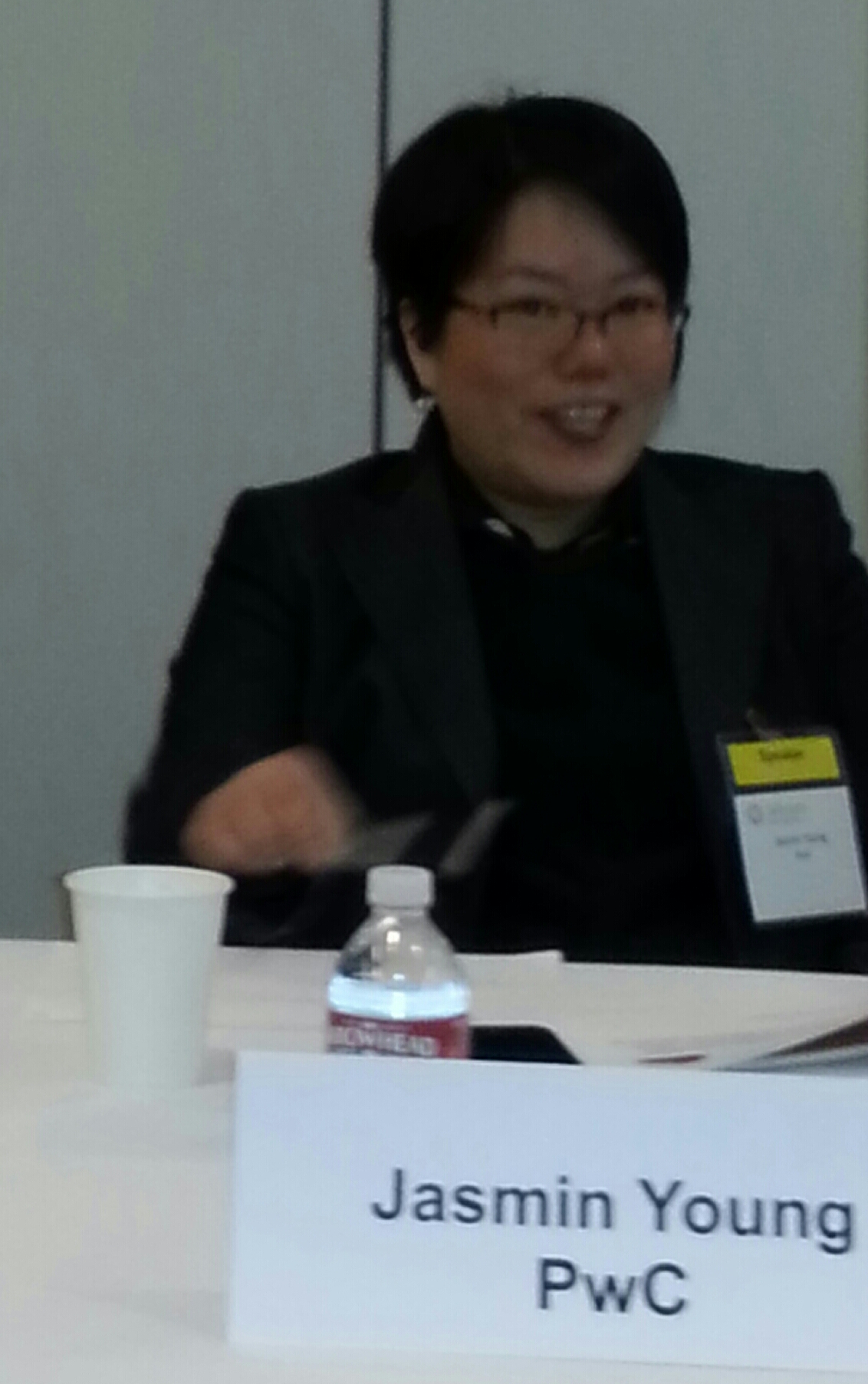
SVForum Panelist Jasmin Young of PwC discusses the fast growth of SMAC at a breakfast event in Palo Alto on Tuesday.

SVForum Panelist Jasmin Young of PwC discusses the fast growth of SMAC at a breakfast event in Palo Alto on Tuesday.

My favorite IT acronym now is SMAC.

SMAC stands for social, mobile, analytics, and cloud computing. It’s an area of IT growing at a phenomenal rate according to  the April 23rd SVForum “Cloudy with a Chance of . . .” Panelist Jasmin Young, director of PwC’s Cloud Center of Excellence.

She quoted a 2013 IDC figure when she said SMAC is a $2.1 trillion dollar market expected to increase to $5 trillion not too long from now.  

Other panelists included Serial Entrepreneur Rajan Raghaven Founder of the The Fabric, which is his sixth company, and VCs Arif Janmohamed from Lightspeed Venture Partners, and Peter Lee of  Bessemer Venture Partners.

The latter two companies manage several billion dollars in funds. The companies they all have backed are an impressive who’s who list of tech firms from Netezza which was acquired by IBM, WebEx which was bought by Cisco and Fusion I/O, just to name a few.

By the way, SVForum is a non-profit organization based in the Silicon Valley that fosters innovation and community among the emerging technology community. Many start-ups, investors and IT executives participate in its many weekly panels, events and mixers.  Law firm Pillsbury hosted the event at its Palo Alto office.

Here are some of the more memorable comments from panelists:

>Jasmin Young, PwC:

  • Fifty-one percent of CEOs say their priority is to grow the customer base.  They also want to create a profitable business, transform operations and create the new IT platform.
  • New technologies are adopted because of how well they work, not how innovative they are.
  • The CIO is not the chief information officer any more. She’s now the the chief innovation officer.
  • Moving IT to the cloud means faster agility.

>Rajan Raghaven, The Fabric — https://svforum.org/Rajan-Raghavan

  • Cloud adoption is real. Many organizations are moving all of their IT to the cloud.
  • 667 exabytes of data is flowing over the internet this year. Big data is growing at 59 percent per year.
  • There are huge infrastructure related issues related to moving to the cloud. A huge transformation is taking place.

>Arif Janmohamed, Lightspeed Venture Partners  — http://lsvp.com/

  • The move to cloud computing has produced big opportunities in big data, networking, software as a service and mobile.
  • It’s about the unboxing of the data center.
  • A long time ago, people moved their money from under their mattresses to banks. Banks then became centers of excellence for security. Now companies are moving their data to the cloud. Cloud centers must be like banks. They also must become centers of excellence for security.

>Peter Lee, Bessemer Venture Partners  — http://www.bvp.com/

  • Eighteen months ago, companies said, “Let’s design with cloud first in mind.”  Now it’s, “I’m a cloud-only shop.”
  • Now it’s how to manage apps across devices and how to maintain governance policies.

Final notes:

IBM was not on the panel but its Cloud Services VP Ric Telford discusses SMAC trends in the “Thoughts on Cloud” blog, so if you are as interested in this area as I am, you might want to check out his posts once in a while.

According to the latest IBM earnings report, Big Blue’s cloud business has grown at a nice rate.  Here’s the URL for the post that mentions SMAC:

 http://thoughtsoncloud.com/index.php/2013/04/the-space-between-where-is-the-real-value-in-smac/

To keep on top of emerging technology trends, follow @SVForum and @FromMichelle on Twitter.

Disclosure: I own IBM stock.

###


Three Trends That Have Drastically Changed the Way I Collaborate

One of my colleagues at the Silicon Valley International Association of Business Communicators (SV-IABC) just asked me about major collaboration trends.

She’ll be on a panel at our SV-IABC luncheon event at Michael’s at Shoreline in Mountain View, California, on Thursday, April 18. Here’s the website to register, or if it’s too late since it’s happening tomorrow, just pay at the door.  http://sv.iabc.com/

I have so much to say on the topic that I decided to blog about it instead of just giving her a couple of quick comments.

 Three trends have affected the way I collaborate in the work place in big ways.

 They are industry collaboration, content marketing and the crazy fast rise of social networking.

 1) Here’s some elaboration on the first one. When the recession hit a few short years ago, industry consolidation grew rapidly. The large New York based company I worked for acquired 100 companies in just about a decade. They were smart strategic acquisitions and today the company is doing quite well just based on the stock price alone.


I had a lot of new coworkers. Many of my PR projects involved working with the new company communications teams.


Because it wasn’t economical to continually fly to all the sites where these new coworkers were, our company started massively collaborating on-line. Instant messaging (IM) became the “norm,” meetings in Second Life became the norm for some groups and then a few years ago, the company standardized on an enterprise social collaboration tool, a sort of Facebook for the enterprise.


Management loved IM because you could better tell if someone was working or not. The challenge was that if you turned it off, for example to focus on writing a press release or to run a meeting, some people thought you were not working.


2) The second trend is the growth of content marketing. More and more, the communications siloes of internal communications, press relations, product marketing, advertising, and web communications have blurred. The company I worked for changed the press relations folks’ titles to “external relations.” We were charged with “finding” and driving news and trend stories that would publicize our key messages and back our growth strategies. These stories might be part of a sales pitch or become the lead news peg on the website. As you know, a nice Youtube customer use story can be used by any group want to demonstrate the value a company provides.


3) The third trend is the crazy fast rise of social networking, especially Facebook.  I have spent the past 12 years mostly physically working alone from my home office, both at my last corporate job and while I consult for my new clients which are mostly software start-ups. However, I do feel like part of my work teams and collaborate in a higher quality manner because I know my faraway coworkers due to getting to know them through Facebook. The vast majority of Facebook friends are coworkers, former coworkers and business partner types.


Yes, I’d see them at a few of our annual events like industry conferences or events we’d hold for press and analysts so it wasn’t all on-line but the on-line connection certainly helped.


However, since LinkedIn has become so popular, I’ve mostly just connected with business associates on that site instead. For example, I’m connected with all of my software start-up clients and new business partners on LinkedIn but not on Facebook.


As a result, my number of FB friends has stayed consistent but my LinkedIn contacts list has grown dramatically.  I’ll elaborate on that topic in another blog someday.


In any case, collaboration is a hot topic and some big happenings in recent history like the rise of social have definitely changed the way we do this task.


I hope to see my Silicon Valley communicator friends at the SV-IABC luncheon on April 18.


Three Trends Driving Demand for PR Now

Multi-ethnic group portrait

I attend a lot of business networking events and talk to a lot of smart, experienced and educated people who are on top of industry trends. I also enjoy talking to people who have just a little work experience. Sometimes the ones who have only a couple of years of work under their belts are more in the know about what’s hot and what’s not. 

The Silicon Valley Public Relations Society of America Future of PR round table earlier this year in East Palo Alto was excellent with Facebook, Dell and others on the panel, as was a meeting I recently had with Global Fluency, a marketing communications and strategy firm headquartered in Palo Alto, Calif. That firm runs the Chief Marketing Officer (CMO) Council.

I used to work at Global Fluency in the early 90s when it was called something else. It was awesome to touch base with Donovan Neale-May who runs both Global Fluency and the CMO Council again after such a long time. The firm seems to be doing just fine and has evolved over the years along with the market.  It was great to see that Executive VP Dave Murray is still there and doing well.

Additionally, I enjoyed the Silicon Valley International Association of Business Communications (SV-IABC) event on gamification in Santa Clara in November.

I took notes at all of these gatherings and have put together the top three trends driving for PR now.

1. The new IR is influencer relations. 

There’s a new acronym in town. It’s IR. No, not investor relations. I mean influencer relations. Because so many people blog now, from large corporations executives and industry analysts to consumers posting on Yelp, organizations should be focused on influence and not necessarily “press relations,” “analyst relations,” or “client relations.” Typically the acronym for external relations is public relations but the term is often misused.

 Public relations actually means “changing someone’s mind.” But over the years, most of us in PR mostly came to know it as press relations.

I advise that all communications departments at organizations globally reorganize their staff and put all of their PR and external communications people in a group called influencer relations. Rumor has it that SAP done a bit of this already and if that’s true, good for them. Nice job IBM for calling its PR team “external relations” because that is a nice start in moving in the direction of the trend.

2. Content marketing is white hot. 

In order to gain attention and make noise in a crowded market place, companies must focus on being great content creators and communicators. It’s called content marketing. They need to hire people who can come up with timely and interesting content.  People with a journalism background do great at this task. Kudos to Global Fluency’s Dave Murray for his recent white paper related to this topic. Here’s the link:  http://www.globalfluency.com/news/index.html

3. Digital marketing is top of mind.

CMO Council and a partner firm recently released a survey (http://tinyurl.com/cckvb3e) that said, among other things, that the thing that most marketers are concerned about is digital marketing. Digitizing everything is a “modern” communications task and it’s an interesting change from decades ago when we just had to hire a graphic designer, write some prose, slap them together, get them printed and mail everything to the intended audience.

I believe the CMO Council survey was much more complicated and meaningful than my summary here, but that was still my key take away from it.

Today the communications expert or marketer creates smart and interesting content and then digitizes it so it can be properly socialized.

It’s wild when you think about communications 20 years ago versus today. Back then, you’d fax a press release to your top 10 reporters or mail a hard copy invitation to 100 customers. Today, you’d socialize survey results on Youtube, LinkedIn, Twitter and Facebook and use the online invitation tool to get everyone to the party.

The funny thing is, I remember asking someone 20 years ago, “What did we do before faxes?”
My 12-year-old who is now begging me for his own Youtube account just asked me, “What’s a fax?”

If you want to keep up on the latest trends, join me and my other IABC colleagues at our March 21st luncheon at Michael’s at Shoreline in Mountain View, Calif. I’m a director with the SV-IABC and I personally invite you to come.  It’s not free but it’s also not expensive and the networking benefits are priceless.

This month’s speakers will talk about the pros and cons of consulting for a big IT corporation. To register, visit: http://www.sv.iabc.com/

###


Tim Draper, a Mountain Lion and the Queen: Lessons in Great Story Telling

mountainlion

Last summer while driving down the mountain from Sierra National Forest at elevation 4,000 feet near Fresno, California, a mountain lion ran in front of my car and down the mountain.

It was the most beautiful animal I had ever seen and was at least 8 feet from nose to tail. I immediately thought, if I could see this rare and gorgeous creature in the wild, then I could do anything.  

Yes, it was by chance and only lasted a few seconds but I increased my chances of seeing it by volunteering as a life guard at a boy scout camp my son had attended. Driving back from camp at dusk didn’t hurt.

A couple of weeks later, my husband and were on the Royal Mile in Edinburgh Scotland at the same time as the Queen of England and happened to catch her walking into a cathedral with her husband Prince Philip and grandson Prince William and Kate.

I was further inspired to do great things after this second awesome experience.  How many people ever see either the Queen or a mountain lion in the wild? I saw both in the same summer.

Later that year I started my own PR consulting company, MMC PR. These brief but remarkable sitings actually did influence me to do this.

I write about the lion and the Queen to show that talking about something that happened to you is way more interesting than just stating a string of facts and figures.

Story telling allows you to engage your audience in more personal manner. And when you engage emotions, you can change attitudes more easily. Were you engaged by the lion story? How could you not be?

Most authorities on business and public relations agree with this fact. Just search “story telling” on one of my favorite sites Harvard Business Review and many stories will come up saying successful communications is buoyed by a great story.

I recently watched a phenomenal hour long Stanford Entrepreneur Center talk called “Calling All Entrepreneurial Heroes” by VC Legend Tim Draper. Here is Stanford’s description of it.


“In this lively presentation, Tim Draper, managing director of Draper Fisher Jurvetson, shares his global experiences funding entrepreneurial heroes who ‘break down walls.’ Draper shares attributes that support viable entrepreneurial environments, and encourages aspiring entrepreneurs to attack established monopolies and to never fear making mistakes.”
 
Tim Draper knows how to tell a story to get his point across. His heroes talk is primarly a string of anecdotes that include challenges in starting the VC industry in Russia and what happened when he met with the President of the Ukraine.
 
Draper starts out by having the audience get up and yell “Wild Things” because the other of that class children’s book had just died and he wanted to create an appropriate and timely tribute.
 
If you are struggling with speaking and truly engaging your audience, watch Draper in action: http://ecorner.stanford.edu/authorMaterialInfo.html?mid=3076
 
For further infomation on the topic, read HBR.org’s story “Story Telling that Moves People” at http://hbr.org/web/special-collections/insight/communication/storytelling-that-moves-people

This informative article adds the tip that great story telling is not always positive. Important tasks are hard to do and showing a challenge or a rejection is sometimes more engaging then just saying everything is coming up roses.

 
###